 The Washington Probe

American politics has become addicted to the language of the next election. The President is losing support, the opposition party is getting stronger, congressional seats are shifting, and one day the nation is promised a reckoning. People like that: when voters are angry, Congress changes, and the system rights itself.
That logic is looking increasingly fragile.
Donald Trump’s approval numbers have deteriorated badly in 2026. Pew put his approval at 30 percent in early October, while Democrats held a significant advantage on the generic congressional ballot. Yet the political lesson Trump seems to be drawing from his unpopularity is not to moderate. It is almost the opposite. He has continued pushing an expansive immigration agenda, pursuing controversial military actions, fighting Congress over spending, and asserting greater control over the federal bureaucracy.
This is what makes the 2026 midterms stranger than the usual referendum on a president. The question is not simply whether voters can punish Trump. The question is whether electoral punishment can still reliably restrain a presidency that has spent years making itself less dependent on Congress.
That is a different problem.
James Madison understood the basic difficulty more than two centuries ago. In Federalist No. 51, he surmised that the people were not to be trusted to check the other party out of a spirit of good will, and thus required “institutional checks” to prevent government from ensnaring one another. He wrote, “Ambition must be made to counter Ambition. The genius of the American constitutional system is that presidents would be virtuous. It was that other centers of power could get the better of the presidents.
The next thing is whether those counterweights are still effective.
Trump’s second term has been a series of hints. His administration has questioned the independence of agencies created to function somewhat autonomously from the President. In June 2026, the Supreme Court decided Trump v. Slaughter, overturning the 1935 Humphrey’s Executor precedent by ruling that Trump can remove an FTC member. On October 19, the Court again refused to revive another lawsuit filed by former National Labor Relations Board member Gwynne Wilcox, further bolstering the President’s removal power.
These cases can look like technical disputes about administrative law. They are not merely that.
They concern who ultimately controls the machinery through which the government acts.
This is where the growing influence of the “unitary executive” theory becomes important. Not every time has there been an idea of authoritarianism; Executive power has always been challenged in America, and both parties have had an interest in maneuvering around it. The more robust version of the theory, however, envisions a presidency with much greater power over the executive branch, including agencies that had a fair amount of independence. Project 2025 explicitly aimed to safeguard the President’s authority against encroachment by Congress, the courts, and the administration.
The difference matters because elections have a timeline. Institutional power doesn’t.
A president can have no popular backing in October and still have very great power in November. He can drive Congress out of town and still control agencies, personnel, enforcement priorities, military decisions, and the vast administrative infrastructure that turns his preferences into action. The ballot box determines election outcomes. Does not automatically recreate the state under that office.
It is a divide between the electorate and the administration that could be one of the issues of American politics.
In How Democracies Die, Steven Levitsky and Daniel Ziblatt stated it more broadly, but in a historical context. The collapse of democracy is seldom a one-off event. Institutions weaken gradually. Norms become negotiable. The rules prove more aggressive than political actors first thought. Over time, the outward trappings of democracy remain intact, yet the spirit behind them has been undermined.
This threat is not a matter of America having to be declared an authoritarian state. This threat does not have to be imposed on America as an authoritarian state.
It is a step too far when the political system has reached a stage where every institutional check is seen as a partisan hurdle, every independent official as an obstacle, and every legal loophole as a chance to expand executive authority.
Another issue, less significant but no less crucial, is that the definition of representation itself has changed dramatically. The Cook Political Report says there are 77 competitive House seats after mid-decade redistricting, down from 87. Wasserman estimated that less than 5 percent of Americans live in districts that will decide control of the chamber.
It would make the “blue wave” idea harder to believe.
A wave implies a mass democratic movement: millions of citizens go up, and the political system follows. However, modern American elections can absorb a lot of popular mood without translating into shifts in power. A party can win more votes nationally and gain a significant advantage among voters, then struggle in the House because district boundaries put a premium on large-scale change.
The outcome is Democrats’ frustration. Voters can feel they spoke loudly, and institutions can answer with a whisper.
That frustration can become a combustible political issue in its own right.
Trump has never considered losing an election as a signal to soften up. He has a confrontational, grievance-driven political style that treats institutional opposition as proof of a hostile institution. A Democratic filibuster of Republicans in the House could then lead to a familiar Washington outcome: subpoenas, investigations, hearings, and potentially impeachment. Still, it could also exacerbate the same politics the filibuster is meant to curb.
That is the trap.
Congress can investigate. It can refuse funding. It can block nominations. It can impeach. But those powers require political will, institutional cohesion, public legitimacy, and other institutions’ willingness to enforce congressional authority. The Constitution provides the structure. Humans still need to control the machines.
The same is true beyond Washington. Election administration, voter registration, ballot rules, polling sites, and access to reliable political information are not “footnot”s” in the”history of elections. They decide if political preferences turn into political participation. Reporting from North Carolina, for example, has focused on the role that language, social media platforms, and simple election facts can have on the political experience of Latino voters – with one study there indicating that those who consumed Spanish-language social-media news had increased exposure to political falsehoods, but that the result does not prove causality.
So there is no need to cancel an election to weaken democracy.
For American political culture, that’s a difficult truth to swallow. The country still sees preserving democracy as a dramatic competition over election outcomes. However, elections are just the first step. The real fight is happening there: someone controls the agencies, some laws are vague and open to interpretation, someone holds sway over the bureaucracy, someone appoints judges, someone fills the ballot box, and someone decides which norms still count.
A Democratic wave would matter. It could impose serious political costs on Trump and place meaningful obstacles in his path.
But it cannot, by itself, restore the old equilibrium.
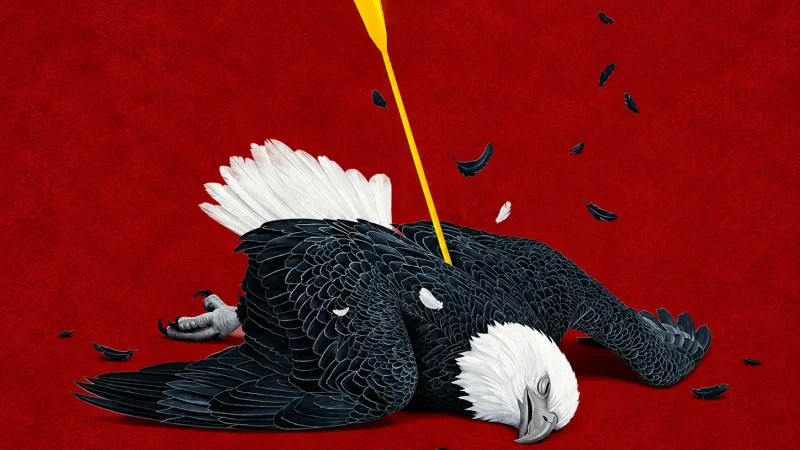
The deeper problem is not whether Republicans or Democrats win the next chamber of Congress. The deeper problem is whether the American system still has enough independent centers of authority to make any president accept limits it doesn’t have; that is a much more unsettling question than who takes the House.
Unlike an election, Americans can’t vote it away on a single Tuesday.
Comments
No comments on this report yet.
Be the first to join the desk.