 The Washington Probe
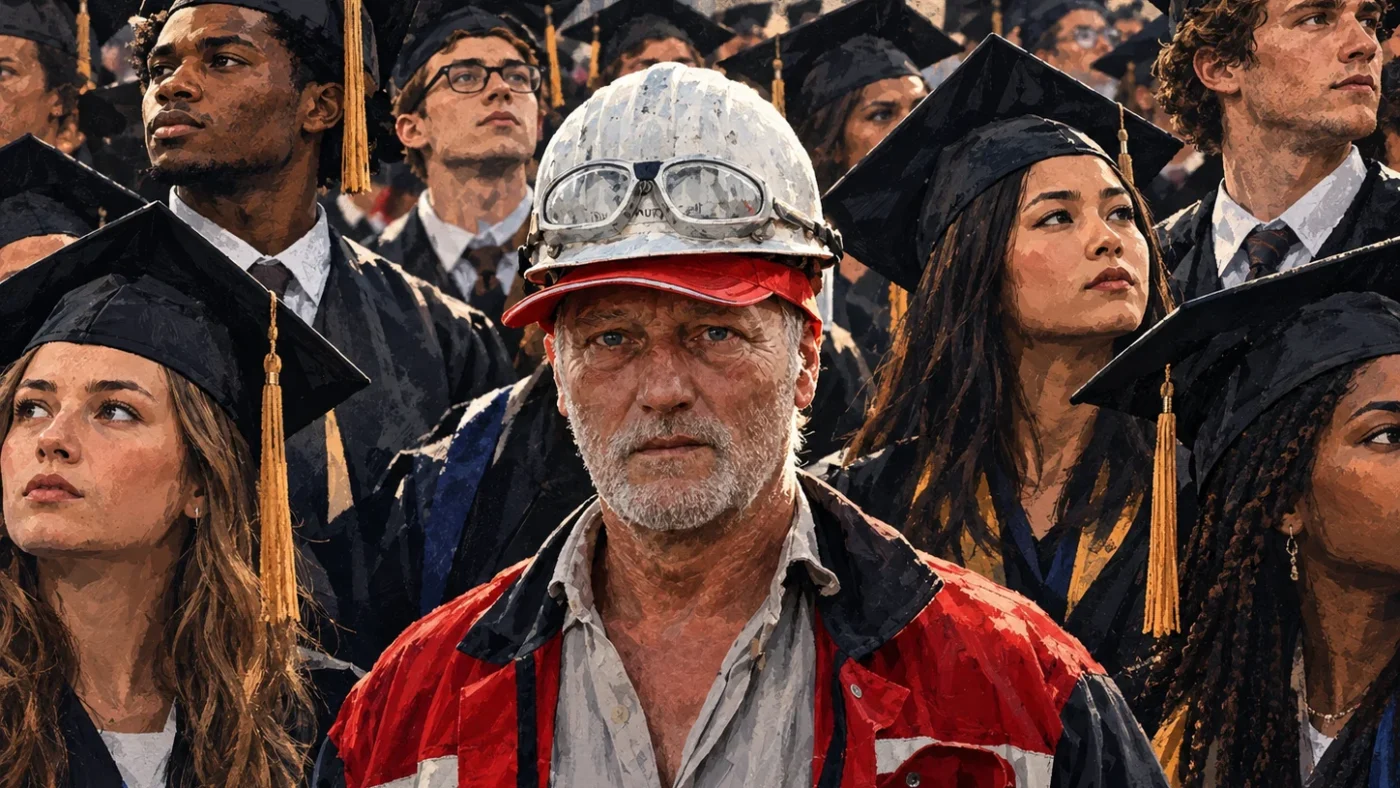
There is something almost comical about the American obsession with the “working class.”
A man who owns a plumbing company, employs twelve people, lives in a house worth $900,000 and has a substantial retirement portfolio can be placed in the same political category as a warehouse picker who rents an apartment, has no meaningful savings and depends entirely on his next paycheck. The distinction between them may be obvious in everyday life. In political language, it can disappear with one checkbox:
College degree? No.
Welcome to the working class.
That shorthand has become so familiar that it now feels like a description of economic reality. It is not. It is, above all, a description of educational attainment. The two overlap. They are not the same.
The confusion matters because class is ultimately about power.
The old question was not simply what a worker earned or whether he owned a diploma. It was whether he controlled productive assets, whether he had bargaining power, whether someone else controlled the terms of his work, and what would happen if his paycheck stopped arriving. A person can earn $100,000 a year and still be economically exposed. Another can earn the same amount while owning a business, a home, stocks, and other assets that provide a cushion against unemployment. The incomes look identical. The power does not.
This vanishing is part of the story of organized labor’s downfall. The Bureau of Labor Statistics introduced the comparable union series in 1983, and the BLS reported that 20.1 percent of the wage and salary workforce were in a union. The percentage was 10 per cent in 2025. In fact, the number of union members has decreased, even though the workforce has increased, since 1983.
Unions once gave “class” an institutional form. A steelworker did not need a sociologist to explain his position. He knew that management could set the terms of employment, and he knew that a collective organization existed to bargain over those terms. Class was something people experienced together at work.
As unions weakened, another institution became much more important: the college credential.
Education was never merely a cultural marker. It became a sorting mechanism. A degree increasingly determined access to occupations, neighborhoods, professional networks, and social status. By 2024, 44.5 percent of employed workers had a bachelor’s degree or higher as their highest educational attainment, according to the Census Bureau.
Then politics discovered that education was wonderfully easy to measure.
Pollsters are allowed to inquire about college graduation. They don’t have the luxury of knowing how much leverage that individual has in the workplace, how much equity they have in their home, whether they own a business, how much debt they have, etc., or how long they would be able to support themselves with their savings in the event of a layoff.
So the proxy hardened into a category.
The political repercussions are now all around. Overall, college-educated voters voted 16 points more for Kamala Harris than voters without a college education voted 14 points more for Trump in the 2024 election. In recent 20 years, Republicans have been building a following among the non-college population, and Democrats have been winning among college graduates, especially whites.
These are true political divisions. They do not have to be class divisions, however.
Take into account the emergence of the professional-managerial class. Credentialed, institutionalized, and specialized knowledge are crucial to employment in professions such as lawyers, administrators, consultants, professors, engineers, healthcare professionals, and corporate managers. Many are employees, not owners. Some are highly paid. Some are financially precarious. Some possess significant assets. Others live in expensive cities where a six-figure salary can coexist with little wealth.
Yet American politics increasingly treats this enormous population as “college educated,” as though the credential itself explains their economic position.
It does not.
A nurse with a bachelor’s degree, a $70,000 salary and $40,000 in student debt occupies a different economic world from an executive with the same educational background, stock grants and a seven-figure brokerage account. Both are college graduates. One exchanges labor for wages. The other may receive a growing share of income from ownership.
This is where assets become more revealing than credentials.
The Federal Reserve’s Survey of Consumer Finances shows how sharply wealth separates households. In 2022, 66.1 percent of families owned their primary residence, and the median net housing value among homeowners was $200,000. Direct stock ownership also rose to 21 percent. Business ownership was only 14.6 percent, but the value of privately held businesses was extraordinarily concentrated: families with businesses employing more than five people had median net worth of about $1.25 million, compared with roughly $155,700 for families without businesses.
This is the part of American class politics that gets lost.
The decisive question may not be whether somebody works with their hands or sits behind a desk. It may be whether they own something that keeps producing income when they stop working.
A homeowner who bought in an appreciating market decades ago is not in the same position as a renter making the same wage. A small-business owner is not economically identical to the employee standing behind the counter. A worker with a paid-off house and a sizable 401(k) has options that a similarly paid worker without assets does not.
And geography magnifies all of it.
Rural counties have become substantially more Republican over the past two decades, while urban counties remain strongly Democratic and suburbs remain closely divided. But geography is not simply a container for political attitudes. It reflects different housing markets, industries, educational institutions, business structures, and patterns of ownership.
A non-college resident of rural Arkansas might own a profitable dealership or a substantial farm. A college graduate in a major coastal city might spend half a paycheck on rent and have little wealth outside an employer-sponsored retirement account. Calling the first person “working class” and the second “middle class” because of education obscures more than it reveals.
The bigger mistake is confusing working for a living with being structurally powerless.
Almost everyone works. The question is what happens when the work stops.
If losing a job means losing the ability to pay rent next month, that is one kind of economic position. If losing a job is unpleasant but survivable because a household has assets, business income, or substantial savings, that is another. The paycheck may be identical. The underlying relationship to the economy is not.
It is responsible for the slipperiness of class language. The term “working class” has multiple definitions these days: non-college, lower income, culturally conservative, rural, wage dependent, economically anxious, socially alienated. The groups do not overlap exactly, but they aren’t mutually exclusive, either.
The politics built around the category inherits the confusion.
Instead of asking who owns, who controls, who bargains, and who bears risk, political discussion too often asks who went to college.
That is a remarkable downgrade in political vocabulary.
A college degree can tell us something important. It can predict voting behavior. It can correlate with income, occupation, and wealth. But it is still a credential, not a class position.
Class begins where the credential ends: at the factory floor, the hospital back office, the dealership, the warehouse, the apartment lease, the mortgage statement, the brokerage account, and the business payroll.
That is where economic power lives.
And that is where American politics has spent years looking in the wrong direction.

Comments
No comments on this report yet.
Be the first to join the desk.