 The Washington Probe
For most of modern American politics, the party was supposed to be the machine. It recruited candidates, raised money, distributed talking points, mobilized voters, and enforced at least some degree of discipline once its members reached Washington.
That arrangement is becoming harder to recognize.
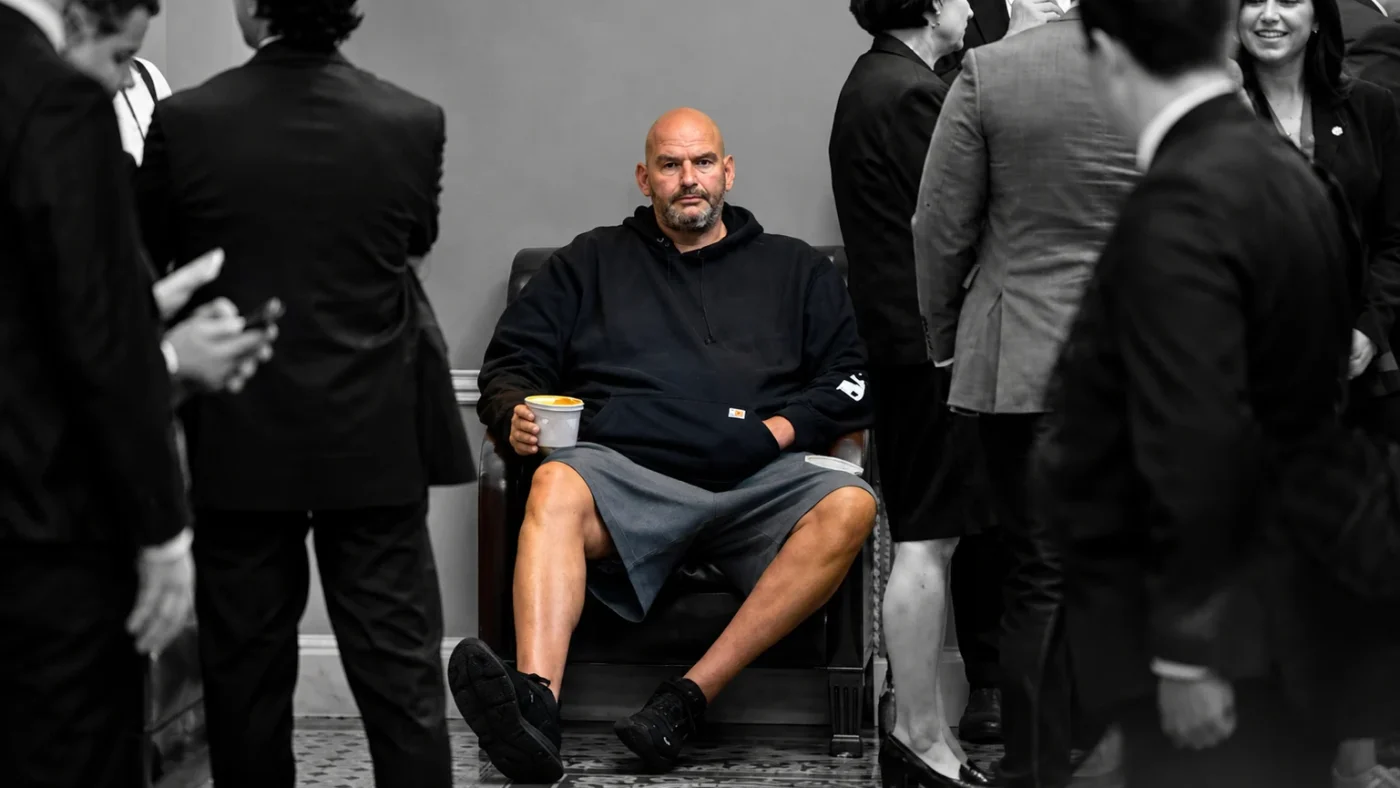
John Fetterman offers an unusually vivid case. The Pennsylvania senator remains a Democrat. His campaign, however, has increasingly operated through political relationships that do not fit neatly inside the Democratic ecosystem. In September, his campaign sent a fundraising appeal through gopsquad.com, a domain associated with Republican political solicitations. Copies of the appeal were also sent through other conservative-oriented domains, including unshakeableconservatives.com and freedomfaction.net. The exact commercial arrangement behind the lists remains unclear; the campaign did not immediately respond to questions.
The significance is not simply that Fetterman is moving to the right.
It is that the machinery surrounding a politician can now become partially independent of the party machinery that supposedly contains him.
The distinction matters.
A party is an institution. A candidate ecosystem is a network.
The first has committees, elected officials, formal fundraising operations, voter files, consultants and rules. The second can be assembled from email lists, podcasts, cable appearances, wealthy donors, social-media audiences, independent political groups and personal relationships. Its boundaries are porous. Its incentives are immediate. And it can cross party lines without requiring the politician to cross them formally.
Fetterman has been constructing precisely this kind of political space.
In July, he and Republican Senator Dave McCormick created Common Ground PA, a joint fundraising committee. Federal Election Commission filings showed that the unusual committee brought together political committees associated with both senators. Joint fundraising committees are normally used by politicians or party organizations to combine fundraising operations; doing so across party lines is unusual.
Fetterman has also appeared in Republican political settings while continuing to describe himself as a Democrat. At the Republican Party’s midterm convention in September, he recorded a video in which he presented himself as a “commonsense Democrat,” rejected socialism and emphasized his willingness to stand apart from political “extremes.” Those themes then appeared again in the fundraising emails directed through Republican-linked infrastructure.
That is more revealing than a single bipartisan vote.
The candidate’s message, fundraising channels, and political audience are beginning to point in the same direction.
The database becomes the constituency
American campaigns have always been personality-driven. What has changed is the infrastructure available to personalities.
The local party machine is no longer the sole source of identifying party supporters for a politician. A campaign can purchase or rent lists of targeted email, grow a following on social media, establish a podcast audience, operate a text-messaging program, be shown on favorite television programs, and develop a donor base that’s more loyal to the politician than to the party.
The result is a political organization that can travel with the candidate.
Fetterman’s Republican-linked fundraising emails are an unusually concrete example because email lists are not merely communication tools. They are political assets. They identify people who can be contacted, solicited, and cultivated again.
The party label can remain Democratic while the campaign begins asking a Republican audience for money.
That would have been difficult to imagine when party organizations controlled much more of the flow between politicians and voters. It is considerably less strange in an era when political identities are increasingly mediated through personalities and digital communities.
Pew Research Center’s 2026 polling offers a useful piece of context. Among registered voters who support Democratic congressional candidates, 52 percent said they preferred candidates who would push hard for their party’s policies even if doing so made governing harder, while 48 percent preferred candidates who sought common ground with Republicans. Among Republican candidate supporters, the comparable split was 58 percent versus 41 percent. The numbers do not show the disappearance of partisanship. They show something subtler: voters themselves are divided over how tightly candidates should be bound to their party’s priorities.
That creates room for politicians who market independence as an asset.
Fetterman has made that independence part of his public identity.
The politician becomes his own media organization
The transformation is not confined to fundraising.
Modern candidates increasingly function as their own media outlets. They do not have to wait for a party press office to distribute their message. A Senate floor speech becomes a social-media clip. A podcast appearance becomes a fundraising email. A television interview becomes campaign material. A provocative vote becomes content for a constituency that may never consume traditional political news.
The politician becomes the brand, while the party becomes one distribution channel among many.
That is what accounts for the fact that ideological conflicts now do not have as harmful an impact as they ever did. A politician doesn’t always have to win the votes of all voters on all issues. The political product can instead be built around a recognizable persona: outsider, fighter, moderate, populist, disruptor, institutional critic.
Fetterman’s recent trajectory illustrates the mechanics. His cooperation with McCormick produced a bipartisan fundraising structure. His Republican convention appearance connected him with a conservative audience. His campaign then appeared to reach into Republican fundraising lists. At the same time, he retained his Democratic registration and continued to describe himself as a Democrat.
The contradiction is the point.
A candidate-centered ecosystem does not have to resolve contradictions. It can monetize them.
What happens to party discipline?
There is a cost to this arrangement, and it is institutional rather than merely ideological.
Parties exist partly to solve a collective-action problem. Hundreds of politicians cannot independently build legislation, raise money, recruit candidates, and coordinate electoral strategy without some organization connecting them.
When politicians acquire independent fundraising bases and direct relationships with voters, that coordination becomes harder.
The problem is not new. Political scientists have been documenting for years how outside activist organizations, donors, and political groups have created alternative routes into electoral politics, weakening the traditional gatekeeping role of party organizations. Brookings researchers Raymond La Raja and Brian Schaffner have argued that these outside pipelines can shift power away from party institutions toward groups with their own interests and incentives.
The next step is more personal.
The alternative institution is no longer necessarily an interest group. It can be the candidate himself.
That changes the incentives inside Congress. A senator with an independent donor base, an independent media following, and a cross-party audience has less reason to fear the traditional consequences of breaking with party leadership. Party leaders can threaten committee assignments or campaign support. But they cannot easily confiscate a politician’s personal audience.
That audience belongs to the politician.
Fetterman is the example, not the whole story
There is a temptation to interpret Fetterman entirely through the question of whether he will eventually become a Republican. That is the least interesting part of the phenomenon.
He has repeatedly rejected speculation that he plans to leave the Democratic Party. In a May Washington Post essay, he argued that working across party lines sometimes put him at odds with Democrats but said he remained committed to the party. He also pointed out that he continues to vote with Democrats on most matters.
The more consequential question is what happens when formal affiliation and political infrastructure begin to diverge.
Fetterman can remain a Democrat while cultivating Republican donors. He can cooperate with a Republican senator while maintaining a Democratic voting record. He can address conservative audiences without becoming a Republican candidate.
None of those facts necessarily requires the others.
But together they reveal a political system in which the party label no longer tells the entire story about where a politician’s political power comes from.
That has implications far beyond one Pennsylvania senator.
The next generation of congressional politicians may increasingly ask a different question from the one their predecessors asked: not Which party controls my political identity? but Which network can sustain me?
Once that happens, parties may still control the ballot line. They may still write platforms and elect leadership. But the real political organization may sit somewhere else—in the donor database, the podcast feed, the text list, the television audience, and the personal brand accumulated by the candidate.
The party remains on the ballot.
The ecosystem is what follows the politician home.
Comments
No comments on this report yet.
Be the first to join the desk.