 The Washington Probe
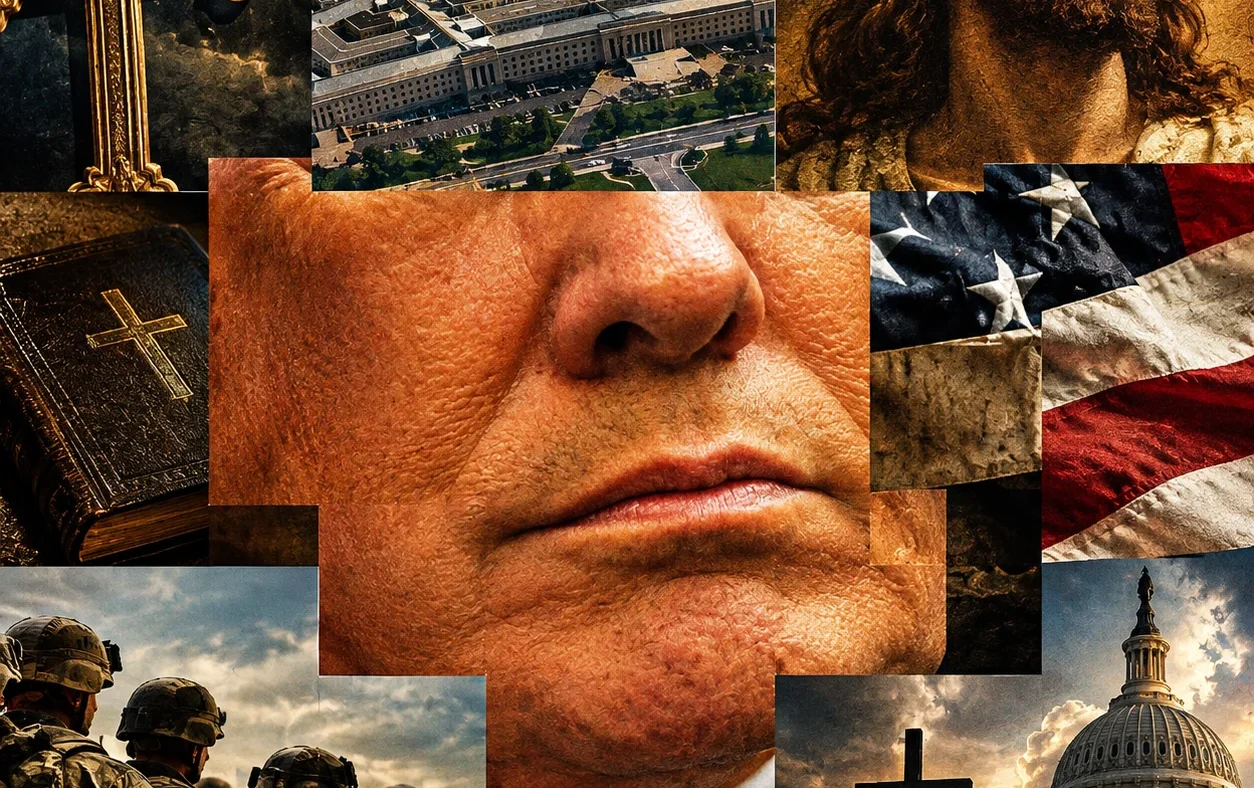
When military power begins borrowing the language of scripture, war can acquire a moral authority that ordinary political arguments cannot easily challenge. The deeper question is not whether American officials should have religious faith, but what happens when faith, nationalism, and the machinery of state violence begin speaking in the same voice.
Pete Hegseth’s public religious rhetoric has made that question unusually difficult to ignore. At Pentagon worship services in 2026, the defense secretary prayed for “righteous targets for violence,” asked that “every round find its mark,” and invoked “overwhelming violence” against enemies who “deserve no mercy.” He has also connected the language of scripture with the ongoing war against Iran.
There is nothing inherently strange about soldiers praying before combat. Armies have always done it. Chaplains exist precisely because people confronting war often need a vocabulary larger than strategy, logistics, and weapons. The question is what kind of prayer is being offered—and what political assumptions are smuggled into it.
That distinction matters.
There is potential for moral ambiguity while praying for military safety, self-control, civilians, wisdom, or a swift end to bloodshed. A prayer that begs God to sanction violence against the wicked after dividing the world into the righteous and the wicked accomplishes something more significant. With the country on one side and its adversaries on the other, it transforms a disagreement over policy into a struggle between good and evil.
Once that happens, disagreement becomes harder. Perhaps the most dangerous feature of sacred political language is not that it makes people more religious. It can make political choices appear less political.
There have previously been instances like this in the United States. Religious rhetoric was frequently incorporated into foreign policy debates during the Cold War, particularly among American evangelicals who viewed international events as a war between freedom and oppression, Christianity and atheism, or civilization and its alleged adversaries. The work of historian Lauren Turek on evangelical involvement in U.S. policy toward Nicaragua demonstrates how religious groups contributed to the theological and geopolitical framing of support for the Contras. In that setting, identifying faith with national policy could intensify a conflict far beyond the practical question of what Washington should do.
The pattern is still older.
Christianity has spent much of its history negotiating an uncomfortable relationship with political power. Augustine’s City of God was written in the aftermath of Rome’s crisis partly to challenge the assumption that the fate of an earthly empire could simply be equated with the purposes of God. Centuries later, Christian thinkers continued wrestling with the problem of whether political authority could legitimately employ violence and under what conditions.
That argument never produced a single Christian position on war. It produced a permanent argument.
Reinhold Niebuhr understood why. In Moral Man and Immoral Society, published in 1932, he warned against assuming that the moral instincts of individuals translate cleanly into collective political life. Groups, nations, and institutions pursue interests through power, and those interests are extraordinarily skilled at presenting themselves as universal moral goods.
Niebuhr’s insight is useful here because the central problem is not hypocrisy. It is something more complicated: power has a remarkable talent for baptizing itself.
A nation rarely says, “We are doing this because we are the stronger side.” It speaks of security, civilization, freedom, justice, order. Religious language can add another layer: providence, righteousness, evil, divine purpose.
That vocabulary can be sincere and still be politically dangerous.
Research supports the idea that religious nationalism can shape attitudes toward both immigration and military intervention. Political scientist Irfan Nooruddin found that respondents who embraced a conception of America as a nation with a specifically Christian identity and divine purpose were more likely, in his surveys, to support certain forms of military intervention and adopt more restrictive attitudes toward immigrants. The point is not that religious believers are inherently militaristic. The finding concerns a particular fusion of religious and national identity.
That distinction is essential.
Millions of American Christians reject the idea that the United States has a special sacred status. Many Christian veterans have opposed wars they believed were unjust. Many military chaplains understand their role precisely as a reminder that the soldier serves a government, not a deity. Christianity contains pacifist traditions, just-war traditions, liberationist traditions, and deeply conservative traditions that disagree with one another about what faith requires.
So the argument cannot honestly be reduced to Christianity versus war.
The sharper question is whether any government—Christian, secular, democratic, or otherwise—should be trusted when it begins presenting its military objectives in theological terms.
That question becomes especially serious when the state possesses extraordinary destructive power.
In 2026, the Iran war has already cost the Pentagon more than $38 billion, according to the Congressional Budget Office, with additional monthly costs projected depending on the intensity of the conflict. The human and strategic consequences extend well beyond the accounting ledger.
At that scale, words matter.
Calling an enemy “evil” is not merely colorful rhetoric. It can alter the psychological distance between killing and morality. A target stops being simply a military objective and becomes an instrument of punishment. The soldier is no longer only carrying out orders; he can be imagined as participating in a righteous struggle.
This is where the invocation of Jesus becomes particularly revealing.
Jesus is not a difficult figure to recruit into politics because he said so little about power. He is difficult precisely because he said so much about it. His teachings repeatedly placed outsiders, prisoners, the poor, the sick, and the persecuted at the center of moral attention. “Love your enemies” is not an ambiguous instruction. Neither is the repeated demand to care for people who possess little power.
A government official may legitimately argue that military force is necessary. That argument can be made in the language of national security, international law, deterrence, strategic necessity, or self-defense. But once violence is presented as unquestionably righteous because God supposedly stands behind it, another burden appears: Who authorized anyone to speak on God’s behalf?
The answer cannot simply be the flag.
Nor can it be a Pentagon podium.
The danger is not that America has discovered religion. American politics has always been religiously charged. The danger is the erosion of distance between belief and authority—the moment a political objective acquires the aura of a sacred mission, and the ordinary democratic questions surrounding it begin to look almost impious.
A democracy needs citizens capable of saying, “We may be wrong.”
Sacred politics has a much harder time saying that.
And war, of all human institutions, is the place where that sentence matters most.

Comments
No comments on this report yet.
Be the first to join the desk.