 The Washington Probe
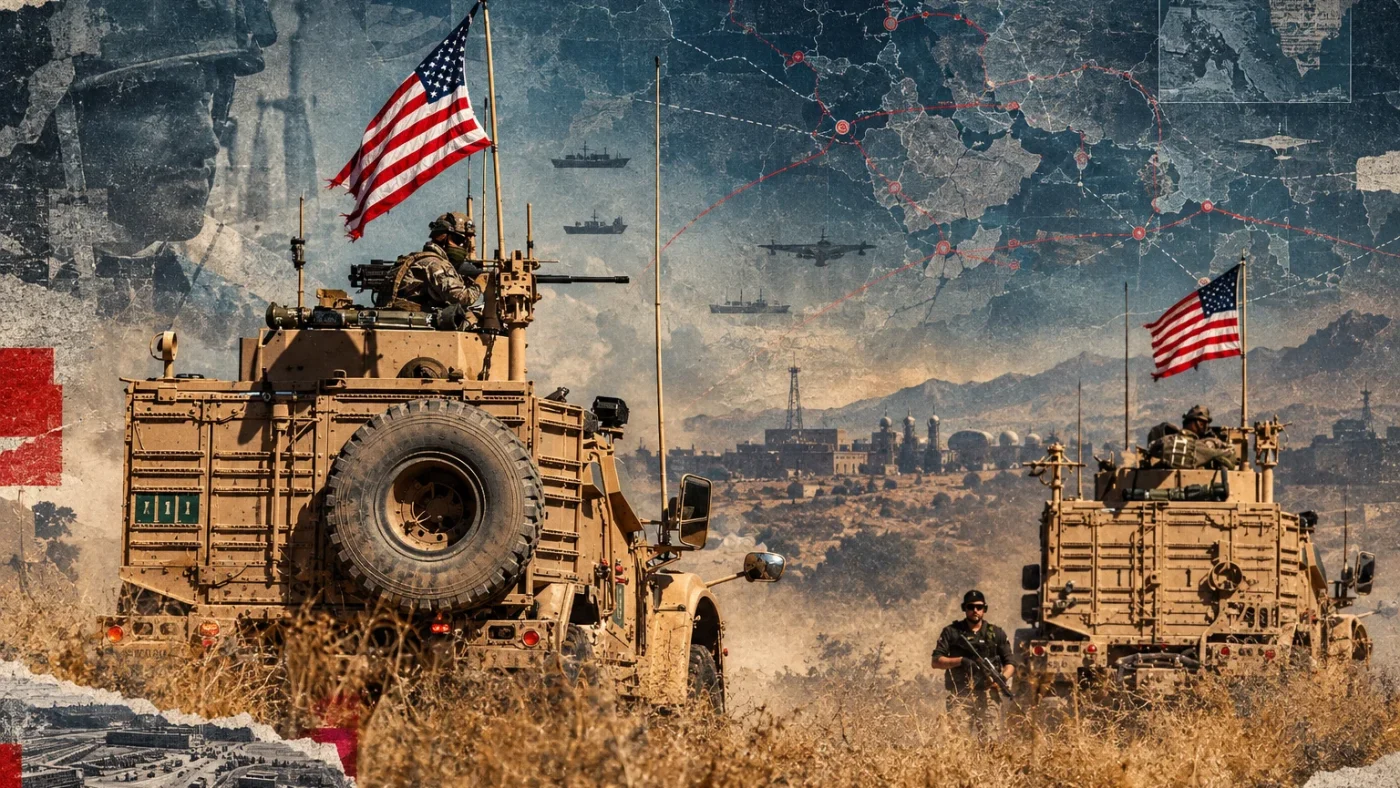
The last U.S. troops left Iraq on Oct. 1, 2026, after being deployed in the country during the invasion in 2003, suspended in 2011, and again deployed, but this time to battle the Islamic State, in 2014. This was a rare occasion when Washington really closed a chapter. However, American forces continued to be deployed throughout the Middle East, influenced by a growing number of commitments and the conflict with Iran. The U.S. exit from Iraq has revealed a contradiction that has plagued American foreign policy for years: the U.S. can declare the mission over without dismantling the same assumptions that led to it in the first place.
This is how military obligations become lifelong affairs. Not by a single big decision to take a territory and hold it forever, but by a series of smaller decisions each of which seems like a quick fix for a problem that can’t be safely deferred.
Machinery is very hard to stop.
Those installations become fixed points in regional military planning and can become targets, prompting a reassessment of security strategies.
The initial goal of Operation Inherent Resolve was to retake areas from ISIS threatening Baghdad, which was achieved by 2017, marking a significant shift. Yet, the U.S. troops stayed to support Iraqi and Kurdish forces, revealing how objectives evolved into a need for new justifications, thus keeping the focus on strategic shifts.
Following that, the attacks came.
Between October 2023 and February 2024, over 60 drone and missile attacks, mostly linked to Iranian-backed militias, targeted American bases in Iraq and Syria, illustrating persistent security threats and the cycle of retaliation.
A vicious circle emerged. Troops remained in place to defend against an enemy, but they also gave hostile groups a means to attack them; attacks on troops justified continued military action; and the resulting insecurity reinforced the case for keeping troops in place.
This does not imply that all attacks result from an American deployment, nor that all deployments lack a legitimate security function. Armed groups have their own needs, and leaving can put local partners in real danger. Too often, however, the potential for additional risks from military presence is discounted as a force-protection issue rather than as a reason to rethink the presence.
A base originally built to solve one issue can become a constant liability, requiring additional money, missions, and force decisions.
Iraq is just one component of the system. American influence in the area is spread across airfields, naval bases, intelligence bases, and logistics bases in Qatar, Bahrain, Kuwait, Jordan, and Saudi Arabia.
As of August 2026, the number of American forces deployed to the broader area was around 50,000, according to Reason’s report this month. Operation Inherent Resolve remained ongoing, with HQ relocated to Jordan, and forward deployments continued well into 2027.
Such facilities offer real military benefits. Airfields reduce response times. Naval bases are established throughout the Persian Gulf. Logistics hubs hold equipment, sustain deployments, and let commanders move forces without building an entire supply chain during a crisis.
The problem is that the infrastructure that enables easier military intervention also makes it easier to decide to intervene.
Once the aircraft, staff, communications systems, and supply chains are in place, they can seem more functional than a diplomatic solution. When a president faces an emergency, he doesn’t have to build a new military option; one is ready. The political consequences of a strike may seem small in the short run; the consequences of not striking seem immediate and personal.
The withdrawal undoes that calculation. It requires dismantling arrangements, negotiating new security relationships, and accepting what might happen without American troops.
Today the risks of this posture are harshly evident in the 2026 Iran conflict. A report by the Congressional Research Service indicated that the Iranian drones and missiles launched at the Gulf states from Feb. 28 to May 17 exceeded 6,700 in number, even after an announcement of a ceasefire in April. The conflict damaged military and civilian infrastructure, and expensive interception systems became central to regional defense.
The conflict does not prove that it was American bases that were responsible for the escalation. It shows something more proximate: when the United States is fully engaged in a regional conflict, safeguarding its personnel, installations, and partners becomes a commitment unto itself. As the goals change, so do the responsibilities.
Having a standing army also creates an economic constituency.
Maintaining bases and expanding operations create economic dependencies that can influence political decisions, prompting the audience to consider the long-term costs of military presence.
The Government Accountability Office has documented the extent to which contractors have relied on Americans in the Iraq and Afghanistan wars, from housing, communications, weapons maintenance, intelligence services, and logistics. It also found that managing and overseeing contingency contracting was challenging.
That’s not necessarily the case for American foreign policy, and not every contract requires an endless war. The interests are not that broad. Defense companies provide the systems U.S. forces and regional partners need. Host governments receive military support and access to the U.S. military. Local institutions are trained to plan for a persistent U.S. presence.
The weapons and basing relationships form a complex ‘ecosystem’ where long-term American occupation benefits multiple parties. Still, this strategic setup warrants a critical re-evaluation of its long-term value and implications.
In 2026, the United States expedited more than $30 billion in munitions and air- and missile-defense sales to several Middle Eastern partners, according to the Congressional Research Service. Such transfers can help partners defend themselves. They also deepen the technical and operational ties through which Washington remains involved in their security.
No conspiracy is needed to maintain the arrangement. Each participant has understandable reasons for wanting continuity. Together, these preferences can make reconsideration politically challenging.
The last hurdle is institutional momentum.
A military command exists to execute missions, not to say a mission is no longer worth a military command. Commanders are assessed on readiness, performance, and personnel safety. Allies request assurances. Intelligence agencies warn about what adversaries might do after a withdrawal. Away they go, lawmakers fearing they will be responsible for the next attack.
The risks of going into exile are tangible and easy to visualize: a resurgence of militancy, an exposed partner, an attack on shipping. The costs of staying are spread across budgets, successive administrations, and regions whose instability can become a permanent part of the Washington agenda.
This imbalance favors “business as usual.” Holding troops in line is often portrayed as prudent, while withdrawals avoid responsibility for whatever comes next.
The outcome is a foreign policy that can stay for any unresolved threat. The weaker a militant group is, the more the mission shifts to training local forces. The training mission could be reduced, and if it is, it could be presented as a deterrent. Force protection is imperative when the base is attacked. If a partner feels vulnerable to abandonment, the United States is advised that withdrawal would harm it.
A new argument always comes up. There are seldom clear cut-offs.
Leaving Iraq matters. It brings back a measure of freedom to a people whose lives have been dominated and influenced for many years by foreign actions. Still, the exit does not remove the threat of armed militias or ensure long-term stability. Those issues require political solutions that permanent American deployments have yet to provide.
However, if the system simply moves its forces to another country and picks up a new mission, withdrawing from one is relatively insignificant.
America should have another standard for military engagement, one that would not simply ask troops if they are making a dent in a threat, but whether they are actually making a dent in it over time, whether there are other ways to meet a need that are less threatening, and whether there are measurable conditions that would allow them to withdraw. Deployments should be subject to genuine evaluation, with the public knowing the cost, goals, and end-of-deployment objectives. Regional cooperation needs to sustain itself without the American presence, not on its own terms, but at a reduced level.
This does not make withdrawal painless. At times it will involve severe consequences. However, the comparison shouldn’t be with a 100% stable peace, but with a situation that isn’t stable at all. It’s about balancing the danger of leaving with the danger of staying in a cycle of limited missions that become open-ended commitments.
For decades, the United States has been learning how to put itself in the Middle East and establish a military presence. It is not as good at knowing when that presence has expired.
Until this changes, all withdrawals will be provisional, all new bases will be potential theatres for conflict, and all stated war-ending statements will be invitations to start the next mission.

Comments
No comments on this report yet.
Be the first to join the desk.