 The Washington Probe
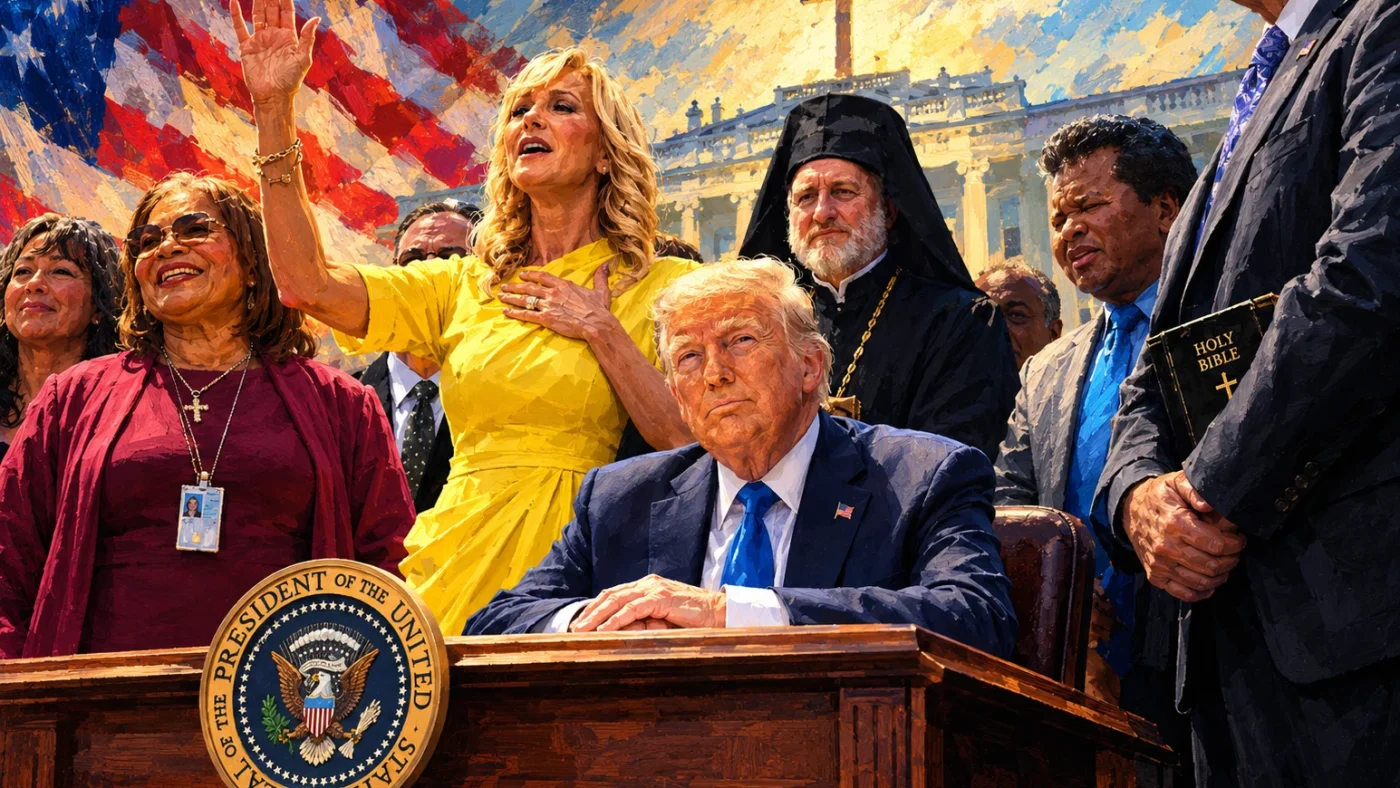
The U.S. has a long history of religion in politics. Presidents call upon God, politicians recite scriptures, and national celebrations make frequent use of the language of religion. None of that, by itself, is remarkable. The more consequential development is something different: the growing tendency to interpret political power itself through theological categories—to understand government, culture, and even war as instruments in a larger struggle between good and evil.
That is where religion stops being merely a source of values and begins to change the meaning of political action.
The New Apostolic Reformation and the concept popularly referred to as the Seven Mountain Mandate are among the most obvious examples. The idea is that Christians should influence and/or control society (made up of spheres: government, education, family, religion, business, media, arts, and entertainment). The movement is characterized as a loose affiliation of charismatic Christians, focusing on spiritual warfare, prophecy, and religious authority, rather than a traditional denomination.
Taken literally, the Seven Mountains are a political strategy disguised in theological language—or perhaps a theology whose political implications can no longer be separated from the strategy. The important point is not whether every evangelical Christian accepts it. Most do not. The point is that it offers a remarkably comprehensive conception of power. Winning an election is only one piece of the project. Schools, television, universities, corporations, families, churches, and government agencies all become contested territory.
That changes what political victory means.
The objective is no longer simply to persuade enough people to support a policy. It becomes possible to imagine politics as the occupation of institutional ground. If a school teaches the wrong values, if a media organization tells the wrong story, if a university embraces the wrong worldview, or if government protects the wrong conception of family, these are not merely policy disagreements. They can be understood as evidence that hostile forces have taken control of part of society.
The language of “spiritual warfare” makes that transformation even more powerful. Once politics is interpreted as a struggle against forces of evil, an opponent is no longer simply someone who is mistaken. The opponent becomes someone who must be defeated.
That is a profound change in democratic psychology.
Democracy depends on the possibility that one’s political adversary can be wrong without being illegitimate. A rival party can win an election and remain part of the same constitutional order. A legislator can pass a law one despises without becoming an enemy of the nation. Compromise is possible precisely because political disagreement does not have to carry moral absolutes.
Theology can complicate that bargain when political disagreement becomes a form of spiritual conflict.
When one side is seen as God’s purpose, and the other side, either explicitly or implicitly, as evil, compromise begins to take a different meaning. It can seem more like giving in than negotiating. Defeat is no longer simply electoral. It can become evidence that the righteous have been betrayed, deceived, or spiritually outmaneuvered.
This helps explain the political power of another idea: restoration.
Movements seeking sweeping cultural change rarely describe themselves as revolutionaries. Restoration is a much more potent political language. If America is imagined as fundamentally Christian at its founding, then efforts to transform its institutions in a more explicitly Christian direction need not be presented as creating something new. They can be described as recovering something that was supposedly stolen or forgotten.
The past becomes a political weapon.
This version of American history is contested, of course. The country’s religious traditions are real and deeply embedded in its history, but so are the Enlightenment principles, religious pluralism, constitutional restraints, and arguments over church and state that complicate any simple story of a uniformly Christian founding. Yet the political usefulness of the restoration narrative does not depend upon historical simplicity. Its strength comes from its emotional logic: America was once closer to its proper identity; America lost its way; someone must bring it back.
“Restoration” therefore turns radical change into historical correction.
Donald Trump did not invent this political theology. Nor did he create the networks that connect charismatic religious leaders, conservative activists, political organizations and institutional campaigns. Those currents existed before him, and there is every reason to expect them to survive him. Trump has shown how useful such networks can become when they find a political figure capable of converting cultural grievance into governmental power.
One example of this is his initiative to establish a White House Faith Office in 2025, in which religion is increasingly formally incorporated into executive-branch policymaking. It was created in the Executive Office of the President and charged with engaging with faith-based groups, seeking counsel from religious leaders, and advising on policies impacting families and communities. The administration has also created agency-level faith positions and emphasized religious liberty and faith-based participation in government programs.
None of this proves that the federal government has become an instrument of any single theological movement. The administration describes these initiatives as protections for religious liberty and partnerships with faith communities, and the Faith Office formally encompasses people of different faiths.
But the larger question is more consequential than institutional labels. What happens when political movements increasingly understand government not simply as a mechanism for administering public policy but as a means of restoring a particular moral and cultural order?
The foreign-policy implications are harder still.
A strategic war has, at least in theory, an exit condition. The objective is defined in political terms: destroy a capability, remove a threat, deter an adversary, protect an ally, force a settlement. Once the objective is achieved—or becomes unattainable—the logic of war points toward negotiation.
A sacred conflict operates differently.
When the enemy is seen less as a geopolitical adversary and more as part of a broader battle between good and evil, military action can gain significance beyond the specific strategic threat. War can prove to be a test of determination, a purifying force, a bulwark against civilization’s collapse, or even a fulfilment of providence. A cease-fire, which should mark the triumph of a political process, can be interpreted as weakness, betrayal, or failure to fulfill a mission.
This is especially the case when the theological understandings of the people Israel, Iran, and prophecy and the end times become part of political talk. Virtually everything is open to interpretation when it comes to religious issues on this topic, and the question of Iran and Israel can’t just be boiled down to theology. However, when geopolitical events are interpreted in prophetic narratives, then military decisions can have an added dimension: the battlefield is part of a narrative that is believed to go beyond the confines of ordinary history.
There, it is important to differentiate between religion and politics and the influence of theology on the political imagination.
The first is inevitable in a free society. Citizens bring their deepest convictions into public life. The second is more difficult. It occurs when political choices become inseparable from claims about divine purpose, when opponents become embodiments of evil, when institutions become mountains to be conquered, and when wars acquire sacred destinations that no ordinary diplomatic settlement can satisfy.
The danger is not that Americans believe in God.
It is that a republic built on political disagreement may have increasing difficulty negotiating with people who believe their political struggle is ordained by God.
And once a war is understood as sacred, the most dangerous question is no longer how to win it. It is whether anyone can still imagine an acceptable reason to stop.
Comments
No comments on this report yet.
Be the first to join the desk.