 The Washington Probe
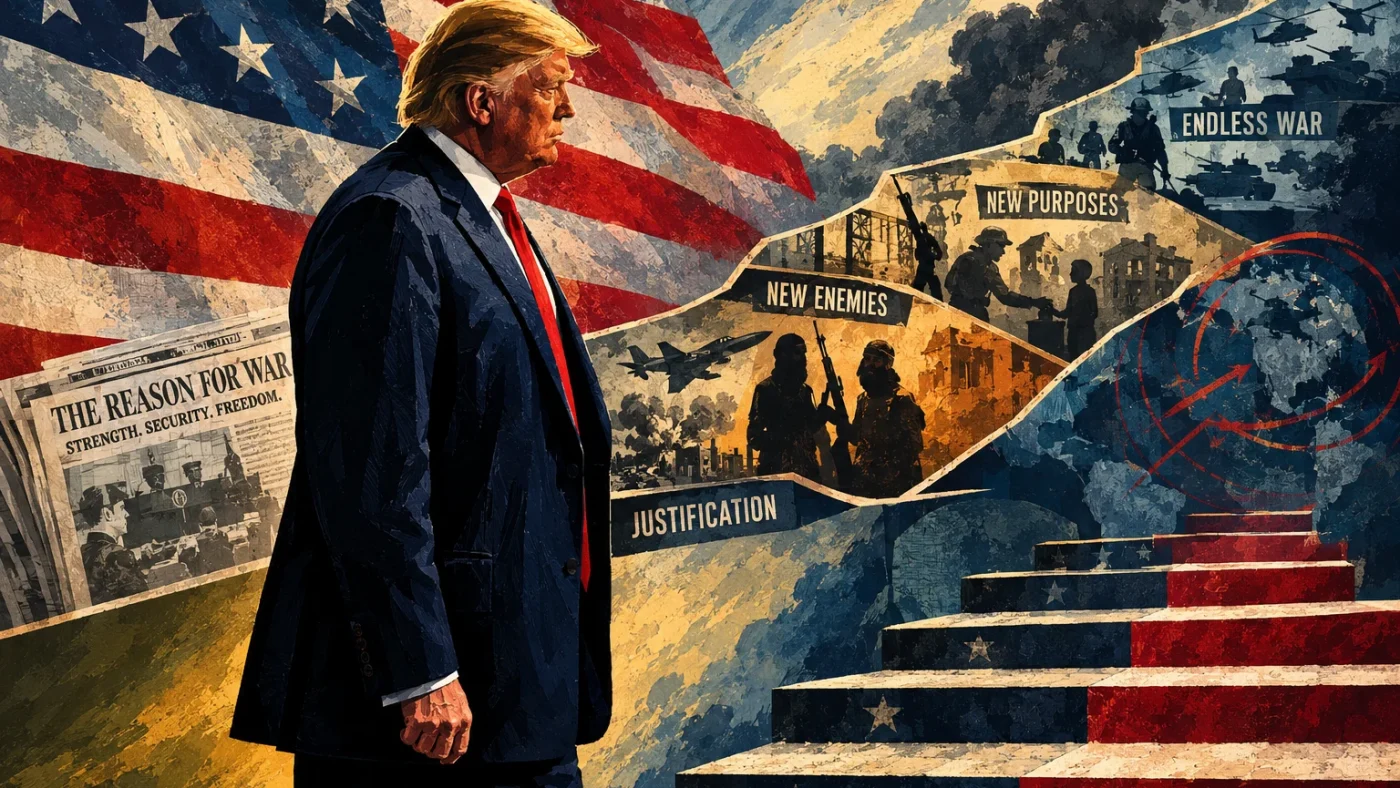
Donald Trump’s appearance before the United Nations General Assembly on September 22 offered a remarkably clear illustration of the problem. He spoke of negotiation with Iran while simultaneously presenting annihilation as the alternative, asking whether he should make a deal that allowed the Islamic Republic to rebuild or “annihilate” it quickly. The contradiction was not incidental. It captured something deeply familiar in American foreign policy: diplomacy is invoked as the destination, while military force keeps being treated as the road to get there.
This is larger than Trump. It is even larger than Iran.
The United States has spent much of the past quarter-century developing a habit in which military intervention is easier to begin than to finish. Wars start with a defined threat. Then the threat evolves. New actors appear. Allies become dependent on American protection. Withdrawal begins to look reckless. What was supposed to be a limited operation becomes a strategic commitment, and the commitment itself becomes evidence that continuing is necessary.
That is how a war develops a life of its own.
After September 11, Congress gave the president sweeping authority to use military force against those responsible for the attacks. The authorization was aimed at a particular enemy and a particular emergency. Yet the logic of permanent counterterrorism soon became much broader than the original battlefield.
Afghanistan became a twenty-year war. Iraq followed under a separate authorization in 2002, with the stated objective extending beyond immediate military action to questions of regional security and the behavior of the Iraqi government.
Then came the next mutation.
The Islamic State emerged from the wreckage of Iraq and Syria, and Washington returned to a war from which it had supposedly withdrawn. In September 2014, Barack Obama announced a “comprehensive and sustained” campaign against ISIS. The administration emphasized that it would not resemble Iraq or Afghanistan because there would be no new American ground invasion. But the operation expanded across borders and continued for years. U.S. airpower struck ISIS in Syria as well as Iraq, while American forces trained, equipped, and supported local partners.
At almost the same time, the supposedly limited counterterrorism architecture in Yemen and Somalia continued. Strikes and partner operations in Yemen were linked by the Pentagon to an ongoing effort, and in Somalia, to ongoing efforts to build up local security forces to counter al-Shabaab.
Notice the vocabulary.
These missions are rarely described as wars that simply continue because nobody has found a way to end them. They are called operations, campaigns, partnerships, stabilization efforts, transitions, deterrence missions. The language changes as the years pass. The underlying military presence often does not.
That distinction matters because it changes what Americans think “ending a war” actually means.
A war does not necessarily need to be declared over to continue. It only needs to remain dangerous enough that withdrawal can be presented as the greater danger.
That is the trap.
Once the United States has troops in a region, removing them can be portrayed as abandoning allies. Once a militant group survives, leaving can be portrayed as inviting its return. Once a rival government is weakened, disengagement can be presented as surrendering the gains already achieved. Every previous action creates an argument for the next one.
The result is an extraordinary asymmetry: the burden of proof falls increasingly on withdrawal, while continuation becomes the default.
Iran now presents that problem on a much larger scale.
Trump says the war was necessary to prevent Iran from obtaining a nuclear weapon. That is the original rationale. But the diplomatic question before the United States is no longer simply whether Iran will pursue a nuclear capability. The questions have multiplied: what restrictions must Iran accept, what military capacity should remain, what happens to the regime, how much economic pressure should continue, what happens in the Gulf, and what guarantees would make another war unnecessary?
The target expands because the definition of success expands.
Trump’s U.N. remarks exposed the tension perfectly. He insisted that a deal remained possible and predicted that Iran could ultimately agree to one after the November midterms. Yet in the same speech he raised the prospect of destroying the Islamic Republic if that agreement did not materialize.
That is not simply contradictory rhetoric. It portrays the mysterious interplay of American diplomacy and American force.
For many years, military force has been the final solution for Washington to appease diplomacy. It’s very simple: show overwhelming power, make them pay exorbitant prices, and eventually they will give in.
Sometimes it works.
But there is a second possibility. The threat itself becomes part of the problem. The adversary responds, the United States responds to that response, regional actors adjust, military deployments increase, and the number of interests supposedly at stake grows. The original conflict is no longer one conflict. It becomes a system.
Iran is particularly dangerous in this respect because the battlefield does not stop at Iran’s borders. A confrontation there touches energy markets, Gulf shipping, Israel, Iraq, the wider Middle East, and the American military presence spread across the region. Even a war begun over one question can generate five more strategic questions before it ends.
And that brings us to the uncomfortable issue Washington rarely confronts directly: what would ending the war actually look like?
Not a temporary pause. Not a cease-fire that leaves the next escalation waiting in the background. Not a “transition” from combat operations to a permanent security partnership. An actual political endpoint.
Afghanistan demonstrated how elusive that can become. Iraq demonstrated how quickly a declared victory can be followed by renewed intervention. The campaign against ISIS demonstrated how a mission designed to destroy one organization can evolve into a continuing military presence aimed at preventing its return. Eventually, the Pentagon itself had deemed Iraq a transition to a bilateral security partnership in the long term, while still conducting counter-ISIS operations in Syria.
This isn’t a claim that all the interventions were actually superfluous or that there were no threats. ISIS was real / al-Qaeda was real. Taliban ruled Afghanistan. Iran’s nuclear ambitions and regional activities are real strategic concerns. The point is narrower and more troubling.
America has become extraordinarily good at answering the question, “Why must we act?”
It remains much less comfortable with the question, “What would allow us to stop?”
That difference can sustain a superpower for decades. It can also keep a country permanently mobilized against a succession of threats that never quite disappear because the strategy itself keeps generating new reasons to remain engaged.
Trump’s Iran war did not invent this machinery. His rhetoric simply makes its logic unusually visible. At the U.N., the president presented negotiation and annihilation as two points on the same continuum, as though diplomacy ultimately rests on the willingness to destroy the adversary if diplomacy fails.
Perhaps the deeper American problem is not that Washington keeps choosing war.
It is that, once war has begun, peace is too often required to prove that it is safe before America is willing to leave.

Comments
No comments on this report yet.
Be the first to join the desk.