 The Washington Probe
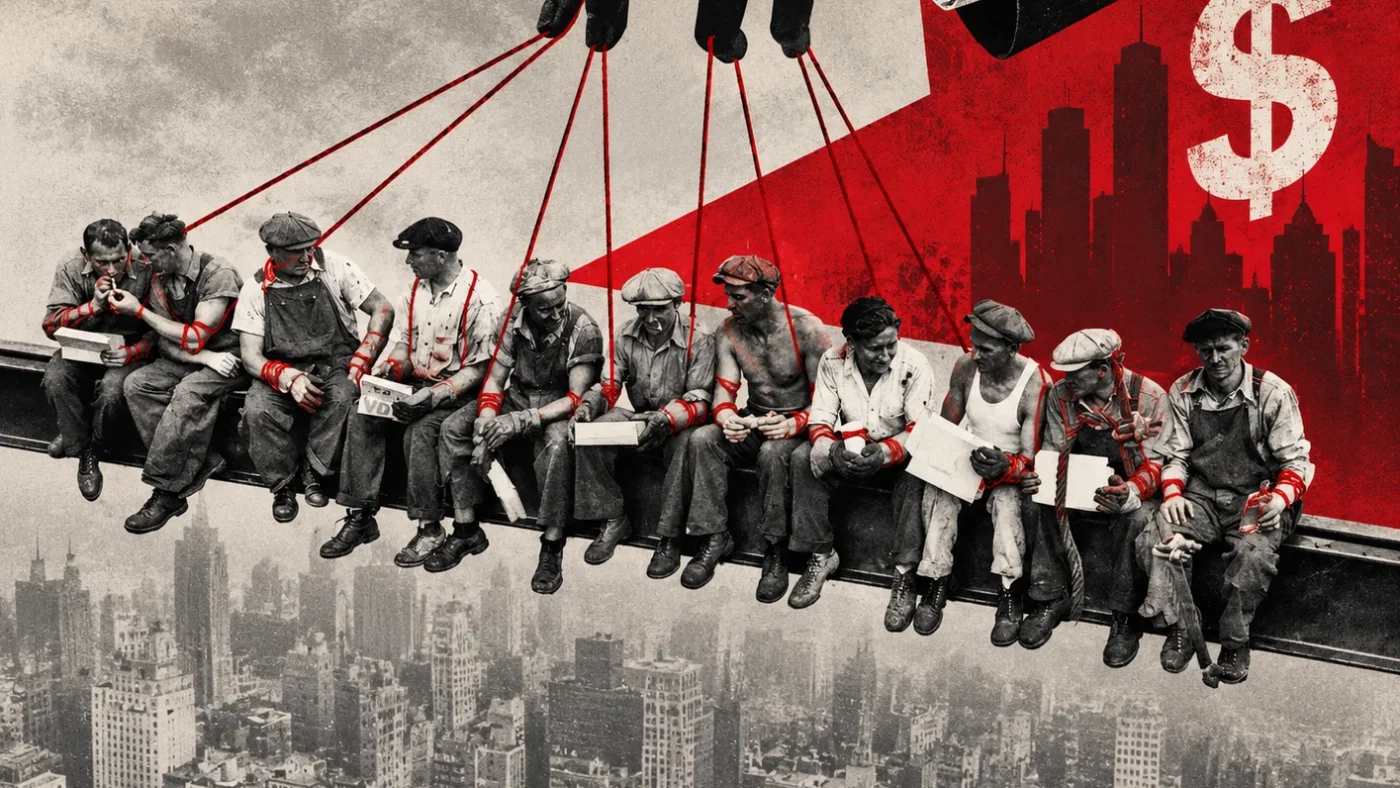
Americans were guaranteed a simple deal: work hard, play by the rules and they would have a fighting chance at a decent life for generations. A job should do more than just give a person money. This meant home ownership, job security, a family, health care and a respectable retirement.
This deal has been in trouble for a long, long time.
The issue isn’t just inflation, globalization, automation, or the transformation of the job market. But underlying all those forces lies a much overlooked aspect of the American political discussion: the weakening of workers’ bargaining power.
Even someone who works full-time may be unable to afford housing, food, and medical care. A corporation may achieve record profits while its workers struggle to maintain their wages, receive inadequate benefits, and have little say in workplace decisions. A government can talk for months about “the American worker” and have policies in place that diminish some of the institutions that workers have traditionally used to assert their power over their government.
That contradiction is particularly stark in Donald Trump’s second term.
Much of Trump’s political career has been based on his self-image as a champion of working-class Americans left behind by the political establishment. In his speeches, he talks about factories, steel, energy and manufacturing, and he promises to bring jobs back home. The appeal is understandable because the economic grievances that underlie it are very real.
Too much language doesn’t measure up a president’s commitment to the workers. The more important question is whether or not the economic life of workers is more under their control because of the policies of the administration.
The answer to that question is much less favorable.
A job does not automatically mean security
In American politics, jobs are seen as the panacea to economic insecurity. The reasoning is common sense: When someone isn’t working, the economy isn’t working; when they are still struggling, someone needs to be better prepared, or better trained, or better equipped with choices.
It isn’t the same as the real economy.
Americans’ primary financial worry in 2025 was still the cost of living, according to the Federal Reserve’s new household survey. Just over one in ten adults ranked price rises as a significant concern, with the percentage of those concerned about finding or keeping a job rising from 37 percent in 2024 to 42 percent in 2025.
Nickel and Dimed is relevant not only because of the insight it offers that having a job is a pathway out of poverty, but also because of Barbara Ehrenreich’s own experience, documented in the book, of working full-time but earning close to the poverty level. Her undercover reporting among low-wage workers revealed that working constantly, putting in countless hours and yet not being able to build a real scalable financial foundation. Whether it’s due to low pay or lack of benefits, the central question that the book poses still remains uncomfortable today: What’s the value of employment if wages aren’t enough to support a secure life?
In On the Clock, Emily Guendelsberger delved into the modern twist of the issue, inside a call center, a McDonald’s, and an Amazon fulfillment center. Her reporting centered on the highly productive workplace, the pressure of time management and constant monitoring. The labor-management power relationship has been transformed by modern technology, but in some ways, the employees have not shared in the benefits.
The work place is more efficient, but not necessarily more democratic.
This is an important distinction.
An answer to the question is not just about the amount of production. It is those who can choose the distribution of the benefits of that productivity.
What happened to the unions?
The decline of organized labor provides one of the clearest answers.
The Bureau of Labor Statistics reported that only 10 percent of American wage and salary workers belonged to unions in 2025, down from 20.1 percent in 1983. There were 14.7 million union members in 2025, compared with 17.7 million in 1983. In the private sector, union membership was only 5.9 percent, while the rate among government workers was 32.9 percent.
Those numbers represent more than the decline of an institution. They represent the decline of a bargaining mechanism.
A corporation negotiates from a position of substantial institutional power. It has managers, lawyers, capital and control over the workplace. An individual employee generally has one major asset in the relationship: the ability to perform the job, and often a pressing need to keep it.
Collective bargaining changes that relationship. Instead of thousands of workers negotiating separately, workers can negotiate collectively over wages, schedules, benefits, safety and working conditions.
Philip Dray’s There Is Power in a Union places this struggle in its historical context. The American labor movement did not emerge because employers suddenly decided to share their wealth more generously. Workers organized, struck and fought political battles to obtain a greater share of the economic gains their labor was producing.
Steven Greenhouse makes a similar argument in Beaten Down, Worked Up, connecting the decline of worker power to broader questions of economic inequality and political influence.
The disappearance of union strength did not make the employer side of the equation disappear.
It simply left workers with less leverage.
Trump’s worker rhetoric meets Trump’s record
This is where the second Trump administration deserves serious scrutiny.
Trump’s political appeal among working-class voters rests partly on the claim that the old political establishment ignored them. That grievance is legitimate. The problem is assuming that political identification with workers is the same as strengthening their position in the workplace.
Federal contractors provide a clear example.
The Biden administration had established a $17.75 hourly minimum wage for many employees working on covered federal contracts. Trump revoked the executive order establishing that standard in March 2025, and the Department of Labor subsequently stopped enforcing it. Under the older framework, the applicable minimum for covered non-tipped workers became $13.65 per hour beginning in May 2026.
There is a legitimate argument over whether the federal government should impose higher wage requirements on contractors. But this was a political decision, not an unavoidable economic event. Washington had established a higher wage floor and then chose to remove it.
The distinction is important because governments frequently speak about wages as if they were entirely determined by market forces. They are not. Governments decide which workers are protected, what standards companies receiving public contracts must meet and how aggressively labor laws are enforced.
Public policy can strengthen worker bargaining power.
It can also weaken it.
The federal workforce became a battleground
The administration’s conflict with federal labor unions is even more revealing because the government was changing the conditions under which its own employees could bargain collectively.
In March 2025, Trump issued Executive Order 14251, excluding numerous federal agencies and subdivisions from the normal federal labor-management relations system by invoking national-security authority. The order affected major departments including Defense, Justice, State and Treasury. Contemporary reporting estimated that the order could affect roughly 75 percent of union-represented federal employees.
Federal unions challenged the order. Courts initially blocked its implementation, but subsequent litigation altered the situation, with the Ninth Circuit later vacating a preliminary injunction against the order and allowing implementation to proceed in significant parts of the government.
The legal questions are complicated, and some remain contested. The political direction, however, is clear enough: the administration sought to reduce collective-bargaining rights for a large part of the federal workforce.
That matters because collective bargaining is one of the principal institutional mechanisms through which employees can negotiate with an employer that otherwise possesses enormous structural power.
A smaller government can also mean weaker worker institutions
Add to that, the administration’s federal workforce cuts.
In 2025, the Government Accountability Office determined that 22 of the largest federal agencies brought on nearly 127,000 employees and laid off nearly 378,000.” Additionally, GAO reported a reduction of over 11 percent in the collective workforce of the agencies under review from December 2024 to January 2026. It is important to note that the “separations” figure encompasses not only firings, but also retirements, voluntary departure, reduction in force and other departures.
Those who are in favor of the administration say that this is necessary in order to cut down the bureaucracy and make it more efficient. That should be considered a serious argument. Certainly, the government can become inefficient and taxpayers deserve to have the government accountable.
A federal employee, however, does not have to face the job loss as a budgetary item. Nor are the public at all untouched when the seasoned employees of a big institution leave.
That is especially relevant when those cuts make the agency charged with ensuring workers’ safety the target.
The National Institute for Occupational Safety and Health was impacted by workforce reductions and restructuring in 2025. Meanwhile, workers were informed of their layoffs as the administration continued on with its sweeping reductions, and there were worries about occupational health and black-lung screening of coal miners, Reuters reported.
That just presents an awkward paradox. While the administration has called for a resurgence of jobs in the American industrial and energy sectors, the institutions that focus on occupational hazards and worker health have been disrupted.
If the worker has to ‘take the expense’ it is no longer a worthwhile employment.
The home-care worker exposes another weakness
In July 2025, the Department of Labor proposed revisions to federal regulations covering domestic-service and home-care workers that would move the rules closer to the older regulatory framework. The proposal could broaden the circumstances in which some workers are excluded from federal minimum-wage and overtime protections. The distinction matters, however: this was a proposed rule, not an immediate repeal of those protections.
Home-care workers are an important example because their work is indispensable while their bargaining position is often weak. They care for elderly people, people with disabilities and vulnerable patients, yet the economic value assigned to that work frequently fails to reflect its importance.
Guendelsberger’s account of modern low-wage employment helps explain why this matters. When employers are able to transfer scheduling uncertainty, productivity pressure and economic risk onto workers, the employee’s freedom becomes increasingly theoretical.
A worker who desperately needs the next paycheck has limited freedom to reject a bad arrangement.
That is the essence of weak bargaining power.
The safety net is part of the bargaining equation
Often the debate about Medicaid and food assistance is disconnected from the debate about work, but it is connected.
The 2025 reconciliation law significantly changes Medicaid and introduces new work requirements for some beneficiaries. According to the Congressional Budget Office, the Medicaid changes would add 7.5 million people to the rolls of the uninsured by 2034. The calculation is not specifically for the work requirement provisions, but for the general Medicaid mandate coverage.
Medicaid and SNAP eligibility was also broadened to include working requirements.
Backers say the government should have a hands-on policy encouraging those who are able to work to stay in the workforce. That makes a good point.
However, it doesn’t mean stable jobs for all in the labor market sector. People move into other roles, either are laid off or have hours cut, are caregivers, get sick, etc. Highly unstable income does not rule out employment for a person.
As support becomes more contingent and jobs are less secure, workers may find themselves facing greater economic risk.
That is a factor that impacts on bargaining power.
If they have savings, health insurance, and a viable safety net, they will have the means to maneuver themselves out of the bad job situation before they will be in the new situation where they are in immediate financial distress due to losing one job.
Economic security is not a standalone construct, but rather a product of worker power.
It is one of its pillars.
Tariffs and the cost of economic nationalism
Another aspect of Trump’s tariff policy is that the politics and economics don’t always align.
It’s easy to see how the push to restore manufacturing to the U.S. came from the desire to improve manufacturing. Those communities who observed a system of industrial failures have every reason for questioning a system of economic reimbursements that encouraged the cheap importation of products but failed to support industries.
But tariffs do not come without costs.
Increased tariffs did not appear to have an impact on most prices, according to the Fed’s economists who conducted research on the tariffs. Their analysis also revealed that lower income families had to bear an unequal burden from welfare and as a result cut down on spending as well as sometimes switching to lower cost alternatives.
That is no reason why tariffs can’t stimulate American manufacturing at times. This implies that their expenses should be taken into account.
Whether or not a factory opens is the wrong litmus test of industrial policy.
It’s whether workers are given steady employment, rising real wages and a larger share of the productivity of their employment.
An American factory can be moved back to the United States, but the working man in the factory can’t.
The issue is not whether unions are perfect
The labor debate is too often reduced to a simple choice between being “pro-union” and “anti-union.”
That misses the larger issue.
The fundamental question is bargaining power.
An individual worker may have a good relationship with an employer. A company may voluntarily pay good wages. A union may sometimes become inefficient or bureaucratic. None of those possibilities changes the basic structural imbalance between a large employer and an individual employee.
The employer controls the job.
The employee needs the income.
Collective bargaining changes that relationship by allowing workers to negotiate together.
This is why the decline of unions matters even to people who have never belonged to one. When workers are better organized, employers know employees possess a credible mechanism for collective action. When labor is fragmented, employers have greater freedom to determine wages and conditions without meaningful opposition.
The history described by Dray and Greenhouse demonstrates that many of the workplace protections Americans now consider normal were not gifts from the market. They were achieved through organization and political struggle.
That history matters because rights once considered permanent can be weakened when the institutions defending them lose power.
The American worker needs leverage, not another speech
American politicians have become remarkably skilled at praising working people. Workers are called the backbone of the country, the people who build America and the heroes of the national economy.
But praise is not bargaining power.
A politician can stand beside a factory and celebrate manufacturing without giving the people inside that factory a stronger voice. A president can promise to restore industrial employment without ensuring that those jobs provide meaningful economic security. A government can celebrate work while weakening institutions that enforce workplace rights.
That is the difference between symbolic politics and economic power.
Workers need labor laws that are enforced, workplace protections with real institutional backing and social insurance strong enough to prevent temporary economic setbacks from becoming permanent disasters. They also need industrial policies that produce genuinely good jobs rather than merely increasing corporate investment.
Above all, they need enough collective strength to negotiate with the institutions that control their economic lives.
This is the enduring lesson running through the books by Ehrenreich, Guendelsberger, Greenhouse and Dray. Work alone does not guarantee security. Productivity does not automatically produce shared prosperity. Rights do not maintain themselves. Institutions matter, and so does the balance of power between the people who perform the work and the people who control the workplace.
The question Washington cannot avoid
For years America has been attempting to fathom the working class rage. Politicians have pointed to globalization, automation, immigration, education, trade policy and cultural change, and various parties have blamed each other for the economic difficulties of average middle-class families.
All of these can be a factor.
However there is a simpler question lurking beneath all of them: What is happening when the influence of the people doing the work, is over time, less than that of the institutions that determine how this work is rewarded?
The erosion of worker power had already begun before Trump and won’t stop when his time as President is over. Yet his second term is an especially telling contrast between the identification with workers and policies that strengthen workers.
The administration backed the recall of an increased wage standard for workers that are covered by federal contractors, took a hard line stance on federal employees’ collective bargaining, led a massive downsizing of the federal workforce and made policy decisions that impact the broader regulatory and economic context within which workers work. Meanwhile, Federal Reserve research shows that the lower-income consumers have been most hurt by the administration’s tariff policies.
This doesn’t need to be some secret plan.
It demands seriousness in the exercise of power.
A government can extol the work ethic of working individuals and have policies limiting the institutional power of working individuals. A factory may be restored but the worker may be insecure in the factory. Tariff can provide shelter to a certain sector, but burden the others. A smaller government can lead to a savings of money without losing any expertise that citizens rely on.
The issue, then, isn’t whether or not Trump has said he cares about the working people.
But are the workers in a stronger bargaining position as a consequence of what his government has done?
It’s a much more complex, and important, question, one that Washington should answer with evidence, not slogans.
The American Dream was never just an offer of a job. It was to be a decent life and ordinary people would have a certain security and influence to give themselves some control of their economic future. In the event workers are put in a more precarious position and given less leverage in negotiating their employment terms, the nation has maintained the spirit of the American Dream while diminishing its content.
In the meantime, Washington can extol the dignity of the American worker, and spare the American worker too little control over the working conditions of the Americans who are performing these labors. The workers of the nation will continue to show up to pay their bills and keep the economy going but the question is easier to state than to answer, especially if working people truly are the backbone of the American economy: If they’re the backbone, why don’t they have a say in the system?

Comments
No comments on this report yet.
Be the first to join the desk.