 The Washington Probe
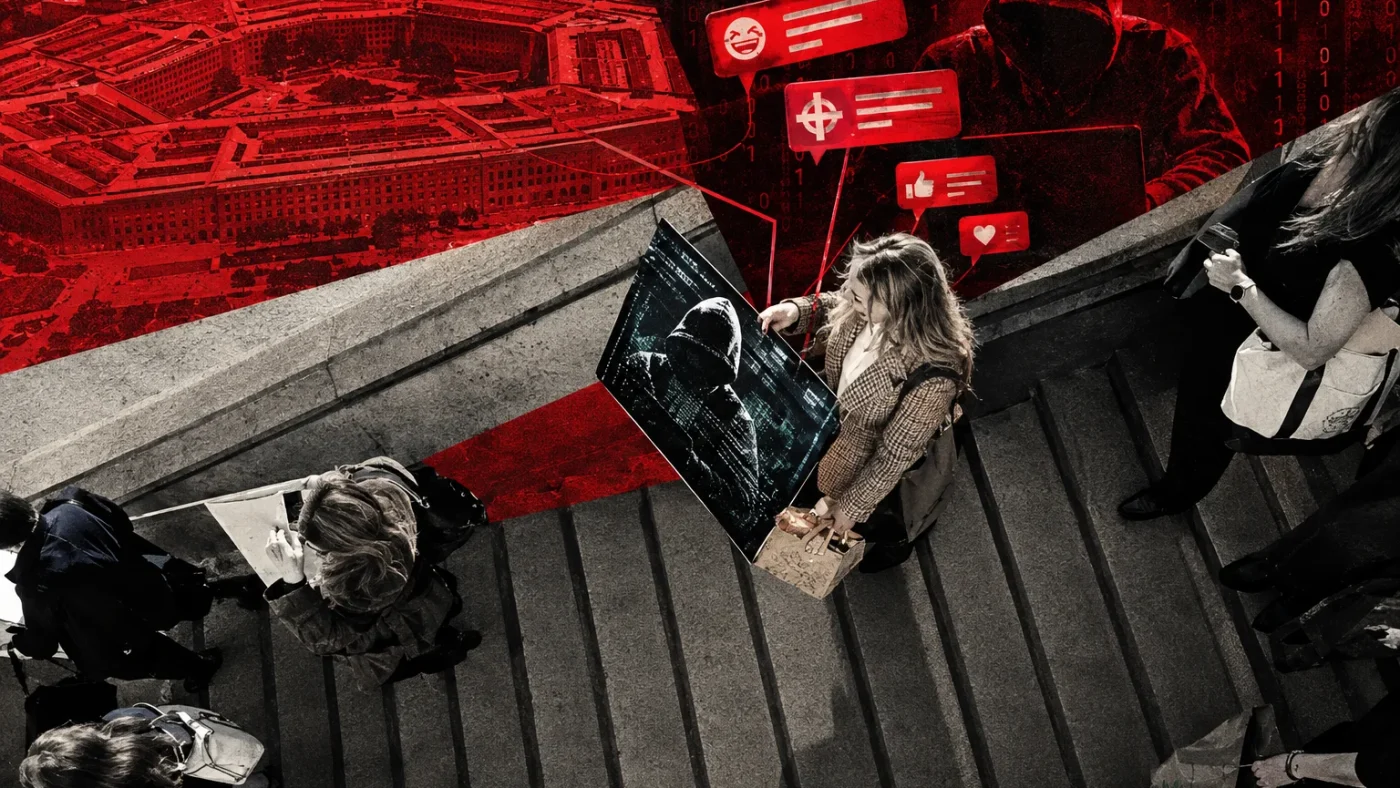
The hacking of NoBlogs is not, by itself, the most disturbing part of this story. Websites get hacked for political reasons all the time. What makes this case worth paying attention to is something else: the apparent overlap between a U.S. government employee, an openly partisan online network, and an anonymous hacker who has made a point of boasting about attacks on people and organizations on the other side of the political divide.
Those connections raise some uncomfortable questions. So far, they have received surprisingly little attention.
At the heart of the story is Jennica Pounds, better known online as DataRepublican. Pounds is a software engineer and online political personality who joined the Pentagon in July. Before that, she had held a credential as a member of the Pentagon press corps. The Washington Post reported in August that the Pentagon had quietly hired a number of well-known conservative influencers and military commentators for civilian positions. In several cases, the department has offered little explanation of what exactly those people were brought in to do.
That matters because AstraRCE has publicly celebrated, promoted or drawn attention to hacks targeting left-wing organizations.
And then came NoBlogs.
On August 26, the U.S. government imposed terrorism sanctions on the Italian digital collective Autistici/Inventati, usually referred to as A/I. The Treasury Department accused the group of providing digital infrastructure and technical services to violent far-left and Antifa networks. In the government’s telling, A/I was not just another technology collective. It was helping extremist groups maintain the digital infrastructure they needed to operate.
Two days later, NoBlogs.org was hacked.
The site was running on infrastructure provided through A/I. The attackers obtained privileged access, defaced the website and apparently took data from the system. A/I later said it had found evidence that information had been exfiltrated and that the attacker may have reached a user database containing email addresses and hashed passwords.
Taken individually, none of these facts proves a coordinated operation. But taken together, they create a sequence that is difficult to ignore—and one that deserves a much closer examination than it has received.
Then came the extraordinary online sequence.
According to reporting by The Intercept, AstraRCE publicized the intrusion almost immediately after the hacked page appeared. DataRepublican followed within minutes. The vandalized site displayed a message claiming that user data had been saved and given to the U.S. government. Soon afterward, AstraRCE asserted that the government had the users’ email addresses and “dehashed” results. One minute later, DataRepublican replied that she could confirm that authorities had everything on the NoBlogs servers.
That is the point at which this stops looking like ordinary internet trolling.
There is still no public evidence establishing that the Pentagon ordered the NoBlogs hack, that U.S. officials participated in the intrusion, or that AstraRCE was acting at the government’s direction. Attribution of cyberattacks is notoriously difficult, particularly against smaller organizations without the forensic resources of governments or major corporations. The evidence does not justify turning suspicion into a claim of a government-run hacking operation.
But the unanswered questions are serious.
How did an anonymous hacker appear to know that government authorities possessed stolen material? How did a Pentagon employee appear able to confirm it almost immediately? Was the information passed privately between individuals? Was it independently obtained from government channels? Was the claim simply fabricated or exaggerated? And, most importantly, what exactly does Pounds’ government assignment involve?
The Pentagon has not provided public answers.
The NoBlogs episode also cannot be dismissed as a single strange online exchange. The Intercept documented a pattern involving DataRepublican and AstraRCE surrounding other attacks on left-wing organizations. After a hack involving Siembra NC, an immigrant-rights group, DataRepublican cited AstraRCE while claiming that hackers had seized control of the organization’s notification system. The account then published what appeared to be a screenshot of an internal dashboard and described messages supposedly sent to users.
In another case involving StopICE.net, a site tracking Immigration and Customs Enforcement vehicles, DataRepublican claimed that information from more than 100,000 users had been sent to federal agencies including the FBI, ICE and Homeland Security Investigations.
Again, these claims do not prove official participation in any hack. But they establish something much harder to ignore: a political media personality who now works for the federal government has repeatedly operated within an online ecosystem that celebrates access to the private information of ideological adversaries.
That is a serious governance problem even before criminal intent enters the discussion.
The danger is partly institutional. Government employees possess access, contacts and credibility that ordinary activists do not. When such employees continue running highly partisan online operations while performing official duties, the public has a legitimate right to know where the boundary lies.
The Pentagon’s quiet recruitment of conservative influencers makes the question more urgent. The Washington Post reported that several right-wing commentators were placed in civilian positions inside the department while their assignments were not publicly disclosed.
It’s not what you would expect to happen between a government institution and an independent political commentator. A new political-media architecture where influencers can be on the inside without giving up the audiences, ideologies and online identities that originally made them influential.
And the NoBlogs affair is an example of the danger of such a structure.
It was finally announced by A/I that it is closing after 25 years. Since the U.S. designation, the collective has indicated that it no longer wants to continue because of the danger to users and communities. Independent reports state that it was responsible for maintaining an infrastructure that served approximately 16,000 email accounts, 1,500 websites, 5,500 mailing lists and approximately 10,000 blogs.
That is, its implications go well beyond the ugly homepage defacement. Government sanctions, financial pressure, digital vulnerability and political targeting all played a role in helping to drive a key independent communications network out of existence.
This is a cautionary tale from the larger story of political hacking. Hackers defaced and stole subscriber and internal data from the conservative publications The Post Millennial and Human Events in 2024. Hacktivists have dumped vast amounts of information on the far-right website Gab and infiltrated extremist groups such as Patriot Front earlier.
That’s not a lesson that one side is doing the entire job of cyber warfare. It does not.
The lesson is that political hacking has become a part of the information war. The difference in the current case is that the information activity that took place was apparently very near to a government employee who is a member of the same information ecosystem.
Democratic governments are supposed to be restrained — exactly where they ought to be.
It is not necessary for the relationship between a state and hackers to be politically significant. It doesn’t even have to discuss it with them in a formal way. The difference between official power and political retaliation becomes blurred as government officials get enmeshed in partisan digital networks that validate the compromise of political opponents.
It should be a concern of all Americans, one way or another.
Today the target is an anarchist blogging collective, an immigrant-rights organization or an ICE-tracking website. The targets tomorrow may be conservatives, journalists, labor organizers, religious groups or political campaigns, under a new administration.
The main issue in question, then, is not whether or not NoBlogs was left-leaning. It clearly was. Nor is the question if the government has any valid cause for investigating violent extremism.
The question is whether government employees are being permitted to operate inside partisan networks where hackers target domestic political opponents — and whether government information is somehow finding its way back into those networks.
Until that question is answered, the NoBlogs affair should not be treated as another internet skirmish.
It should be treated as a warning about what happens when the firewall between state power, political influence and cyber retaliation begins to disappear.
Comments
No comments on this report yet.
Be the first to join the desk.