 The Washington Probe
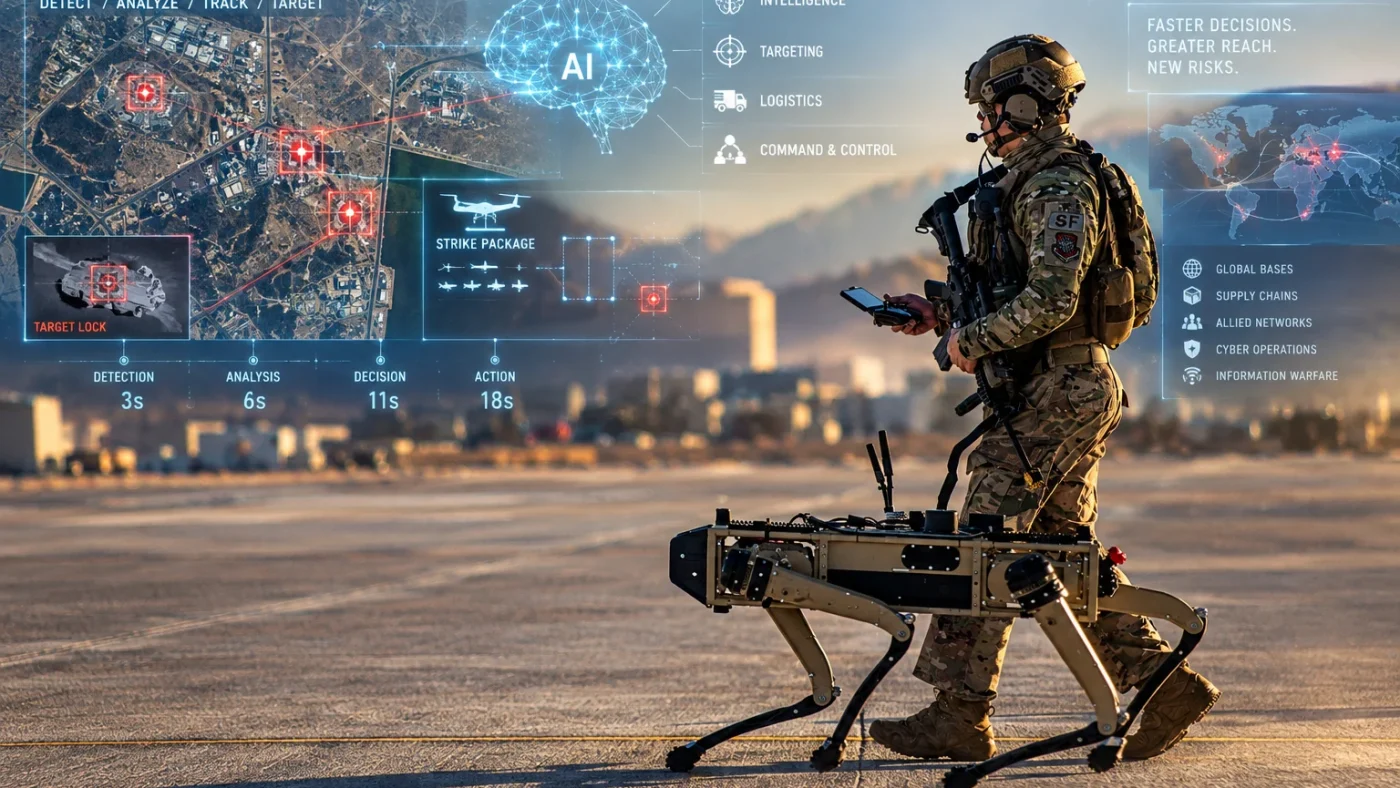
For years, military artificial intelligence was presented as a future capability: useful, promising, expensive, occasionally temperamental. Project Maven began in 2017 as something almost prosaic—a Pentagon effort to help analysts sift through the ocean of drone video that humans could no longer watch fast enough. The original problem was information overload.
That problem never went away. The solution changed.
During the 38-day U.S. air war against Iran, the Pentagon’s use of Palantir’s Maven Smart System exploded. According to Pentagon officials speaking to Breaking Defense, the system was used for about 13,000 targets or strikes throughout the battlespace by Pentagon planners and military staffs. Unclassified usage rose 38 percent from the prior month, while classified use rose 89 percent. Peak daily energy use rose by 4,425 percent to approximately 20 billion tokens per day. Cameron Stanley, the Pentagon’s chief digital and artificial-intelligence officer, said the department was seeing a dramatic increase not only in usage but in the computing power required to support it. His biggest fear, he said, was not the adversary. It was whether the Pentagon could keep up.
That sentence should be read literally.
The United States is no longer debating whether military AI belongs in war. It is discovering what happens after an army begins to depend on it.
In March 2026, Deputy Defense Secretary Steve Feinberg ordered Maven to become a program of record, meaning it would be a permanent military capability, not an experiment. The decision would accelerate adoption across the services and provide “stable funding” for the system, Reuters reported. Maven was already a command-and-control system that received information from satellites, drones, radars, sensors, and intelligence reports, and used software to analyze potential threats and targets.
A Pentagon official said that by September, the number of people using Maven Smart System had risen to over 100,000, up from about 50,000 in January.
That is not a pilot program.
It is infrastructure.
The First Problem Is Not Intelligence. It Is Plumbing.
The First Problem Is Not Intelligence. It Is Plumbing.
The hype around military AI often revolves around the final link in the chain—the autonomous drone, the missile that autonomously targets its own, the robot soldier.
The bigger change is happening earlier.
To build a modern military AI system, you need data centers, processors, secure networks, storage, cooling, power, identity management, classification controls, software interfaces, tactical radios, enough bandwidth to move data between these elements, and satellite links. The glamorous part is the model. The unglamorous part is everything keeping the model alive.
The Pentagon has known this for years.
Senior military leaders, who were talking about the early shape of joint AI and cloud systems, cautioned that cloud services, network enhancements and identity management were not “optional extras”. Deployable tactical cloud infrastructure would be required as compute and storage shifted toward the edge of the battlefield. Without an enterprise cloud architecture, officials warned, experimentation might continue, but the department would eventually exceed its own capacity.
The problem becomes harder in an actual war.
An Army publication in 2025 described continuously connected AI as impossible under tactical bandwidth constraints. It cited estimates that some leading AI platforms can require networking capacity vastly beyond what tactical formations can provide, making edge computing necessary for forces operating in environments where communications may be jammed, interrupted, or destroyed.
The military already has a name for the nightmare: denied, degraded, intermittent, and limited communications.
DDIL.
A cloud-dependent force fighting an adversary capable of attacking satellites, jamming radios, severing fiber, disrupting GPS, and striking command posts cannot assume that the network will remain available simply because the software is excellent. The machine may be brilliant and still be unreachable.
That is why the Pentagon and its contractors are pushing AI toward the tactical edge, putting computing hardware closer to sensors and operators. During the Air Force’s Mobility Guardian exercise in 2025, commercial and military partners tested ruggedized, air-gapped edge infrastructure designed to run secure workloads without depending continuously on a distant cloud.
This causes an uneasy turnaround.
AI should have relieved complexity. Instead, each new AI feature adds another infrastructure component that must be powered, secured, updated, connected, and defended.
There is no free computation in war.
There are servers in racks. There are generators. There are cooling systems. There are satellite terminals. Cables are buried underground, and radios carry enormous quantities of data through electromagnetic space. Some technicians have to replace failed hardware while someone is trying to kill them.
And then there are the chips.
The broader U.S. defense industrial base still has serious visibility problems. A Government Accountability Office study in 2025 found the Pentagon couldn’t determine where all the microelectronics used in the goods it buys came from. Defense officials estimated that 88 percent of microelectronics production and 98 percent of assembly, packaging, and testing are done overseas, mainly in Taiwan, South Korea, and China. The numbers cited are not specific to AI accelerators but provide a glimpse into the broader industrial reliance under the digital military.
The Pentagon has spent billions to reduce that exposure, including billions on microelectronics and advanced packaging. The fact that it must do so tells the story.
AI is not weightless software.
It is industrial policy with a user interface.
The Quiet Revolution Is Happening Before the Trigger Is Pulled
Project Maven began with image recognition. The system being built around it is something much larger.
Palantir describes Maven Smart System as a live, synchronized view of the battlespace, with automated object detection and centralized target identification and management. It can fuse imagery with other information, search massive databases of reports, prepare summaries, and suggest potential courses of action, Pentagon officials say. According to Army records, the system integrates sensor, targeting, and logistics data into a single operating picture.
This is the part of military AI that receives far less attention than autonomous weapons.
It may matter more.
A war is not a single pull of a trigger. It is an endless sequence of classification, correlation, prioritization, routing, and prediction.
What is that object?
Where did it move?
Does this radar track match the satellite image?
Is that truck a weapons carrier or a civilian vehicle?
Which target matters most?
What aircraft are available?
What route is safest?
Which unit has ammunition?
Which intelligence report contradicts another one?
Which target was destroyed, and which one only disappeared from the sensor?
Humans used to handle enormous portions of this work with staffs, spreadsheets, radio calls, PowerPoint slides, and institutional memory. The Pentagon has spent years trying to collapse those layers into software.
Its own AI strategy called for AI capabilities that would produce superior battlespace awareness, faster and more precise kill chains, adaptive force planning, and more resilient sustainment. It also called for interoperable, federated infrastructure and stronger data management.
JADC2—the military’s Joint All-Domain Command and Control project—rests on the same premise: modern warfare produces too much data for traditional command structures, so sensors, networks, automation and AI must help the force “sense,” “make sense” and act across domains at speed.
The machine is entering the military not through a dramatic doorway marked AUTONOMY.
It is entering through staff work.
And staff work is where dependency becomes difficult to see.
Even if software recommends a commander, the commander still has the final say. However, this choice is influenced by what the software brings to the fore, what it excludes, the ranking it provides, and how quickly it makes the information available.
The battlefield doesn’t have to be completely autonomous to be machine-curated.
That distinction matters.
It also creates a dangerous temptation to confuse human presence with human control.
The Human Being at the End of the Pipeline
The Pentagon insists that people remain responsible for using force.
That is not merely public-relations language. It is embedded in formal policy. The Defense Department’s directive on autonomous weapon systems requires commanders and operators to exercise appropriate levels of human judgment and care. It requires systems to be tested, evaluated, and use to be consistent with the law of war. The department’s AI ethics framework also calls for responsible human judgment, traceability, reliability, and auditable development practices.
The legal architecture is clear.
The battlefield is not.
The difficult question is what meaningful human judgment looks like after software has reduced a problem from hours to seconds.
That is not theoretical.
In a 2026 demonstration described by Reuters, Cameron Stanley said a task that once took hours could now be done dramatically faster with Maven. The system can receive signals from a variety of sensors and intelligence sources, and quickly bring up potential targets. According to Palantir, they don’t make the decisions; they just make the recommendations, and humans decide which targets to pick and approve.
But the commander’s legal responsibility and the recommendation’s technical origin are becoming increasingly distant.
The person who approves a target may not know why one signal was weighted more heavily than another. He may not know which training data produced a classification. He may not be able to reproduce the model’s reasoning. He may simply know that the machine has identified an object, assigned a probability, and placed it on a screen.
The individual still has authority.
But authority is not the same as comprehension.
The Pentagon’s own historical record offers a warning about this distinction. In 2017, Project Maven officials described a central problem: no off-the-shelf “black box” could deliver everything the military wanted. Data had to be labeled, systems built, models trained, and commercial partners brought in.
Nine years later, the black box has not disappeared.
It has multiplied.
It sits inside layers of software, commercial infrastructure, classified data, contractor code, and military workflows.
And this is where another war offers a grim cautionary example.
Human Rights Watch has examined Israel’s use in Gaza of several digital tools, including the Gospel, which generates lists of buildings or structural targets, and Lavender, which assigns numerical assessments to people based on suspected affiliation with armed groups. Human Rights Watch warned that such systems can dangerously depend on incomplete data and can concentrate excessive authority in the hands of operators.
Reporting based on interviews with Israeli intelligence personnel described some human reviews of Lavender outputs as lasting as little as 20 seconds per target. One officer described the human contribution in starkly dismissive terms, saying it amounted to little more than a stamp of approval. Israeli authorities have contested those accounts, and they do not establish how the U.S. military operates Maven. But they expose the central problem with the phrase “human in the loop.” A person can be formally present while exercising very little substantive independence.
That is the real danger.
Not a robot making decisions without humans.
A human making decisions inside a system that has become too fast, too opaque, and too operationally important to challenge meaningfully.
The Pentagon Is Building for Speed—and Inheriting Speed’s Moral Hazard
The Defense Department has repeatedly described AI as a way to gain “decision advantage.” Its 2023 strategy explicitly tied AI adoption to faster decisions, more precise kill chains, and improved military effectiveness. The CDAO’s later programs broadened AI deployment into command and control, intelligence, logistics, planning, weapons development, cyber operations, and autonomous systems.
That is sensible from a military standpoint.
Wars punish slow organizations.
However, speed has a price.
If all parts of the military process move quickly, there is less time to question assumptions, review intelligence, spot anomalies, or wonder whether an action on a “must do” list is really required.
The machine need not be incorrect frequently to make a problem.
It just has to be incorrect in a system that kills itself too quickly.
Once institutions get used to that pace, they perceive slowing down as failure.
This is how dependency develops.
At first, AI is useful.
Then it is faster.
Then commanders begin planning around it.
Then staffs are reorganized around it.
Then contracts are written around it.
Then infrastructure is built around it.
Then the Pentagon designates the system a program of record.
Then tens of thousands become hundreds of thousands of users.
At that point, switching it off is no longer a technology decision.
It is an operational decision.
And operational decisions made under fire are rarely made calmly.
The Real Vulnerability May Be the System Beneath the System
The United States is exceptionally good at building powerful machines.
Its harder problem has always been building institutions that can handle the consequences of those machines.
The Pentagon’s own records show the mismatch. GAO says the department has struggled to name its AI staff and predict what it will need next. GAO also reports weak spots in how AI is bought, how cloud systems are run, and how well leaders can see parts moving through the defense supply chain.
The infrastructure problem extends beyond military bases.
AI itself is becoming an energy problem. Data center power use rose fast in 2025. The International Energy Agency expects data centers to use about twice as much electricity by 2030 as they did in 2024. In the United States, data centers are set to take a large slice of new power demand.
So, a force that aims to use AI across many settings needs a full support system. That means power, chips, cooling, links, and secure computing where it counts.
That includes places where the enemy is actively trying to make those things disappear.
The Pentagon has crossed an important threshold.
It no longer needs to prove that AI can be useful in war. Iran has already provided an operational demonstration at extraordinary scale. Ukraine is taking a new approach. Its units are using battlefield systems such as DELTA to merge live data with control steps and detection tasks during daily missions. Ukrainian officials report that AI work is not limited to images. They say it is also used with radar, artillery feeds, sound signals, intelligence notes, and old records.
What happens next is the real question.
If a force leans on fast machine choices, it will also need a separate layer that can support the basics. Power must stay on. Chips must keep arriving. Links must remain up. Data handling has to be done the right way. The tools and models have to be tested again and again. And people must have enough authority to refuse an unsafe order.
That second military is less visible.
No cinematic images of it.
Just server racks, fiber cables, satellite terminals, diesel generators, software contracts, chip factories, and people staring at screens.
Yet that may be where the future of American warfare will actually be decided.
Because the most frightening possibility is not that the Pentagon builds a machine that can wage war faster than humans.
It is that the Pentagon builds a military that can no longer fight effectively without the machine.
At that point, AI is no longer a weapon.
It is the battlefield itself.

Comments
No comments on this report yet.
Be the first to join the desk.