 The Washington Probe
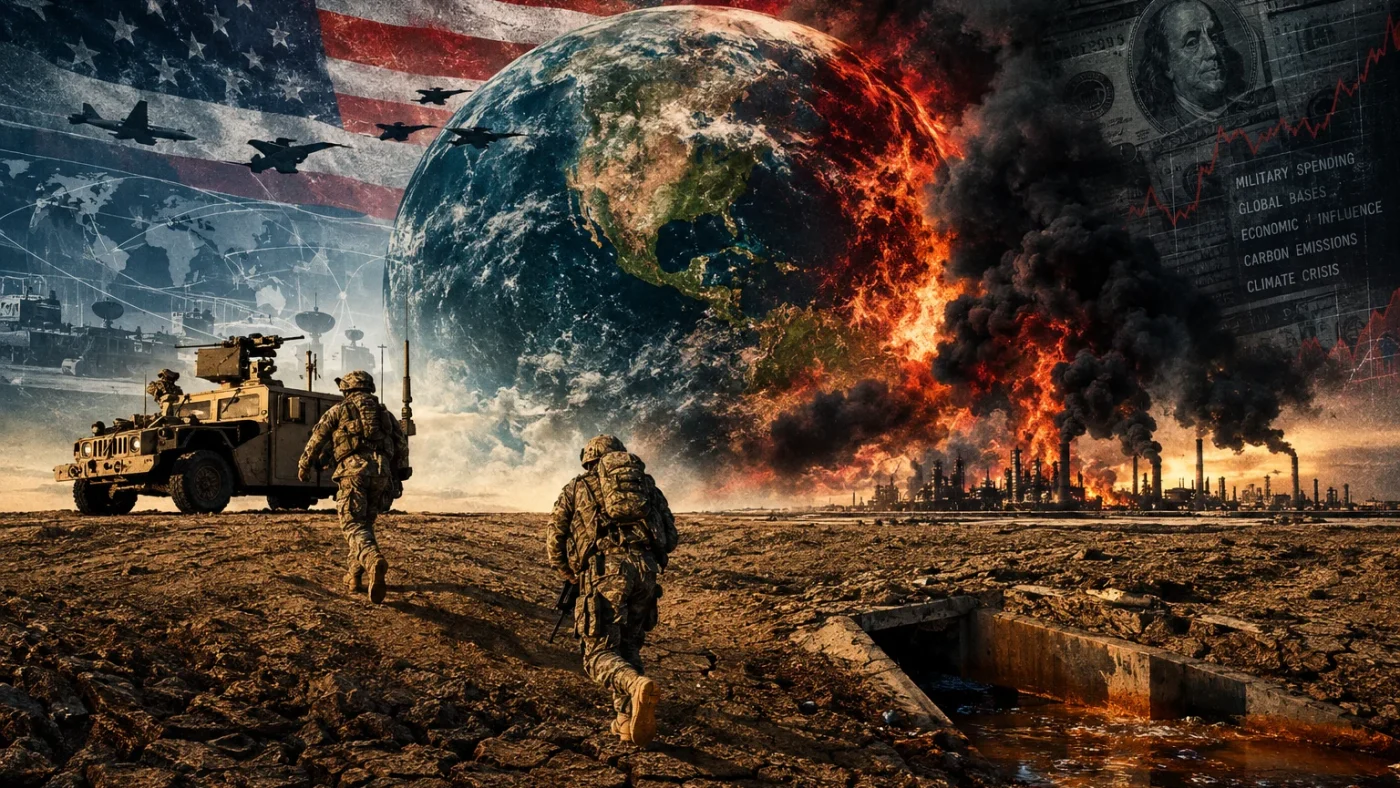
Matt Huber’s argument in Jacobin is provocative because it changes the scale of the climate debate. His phrase, “ecological imperialism,” asks us to look beyond smokestacks, automobiles, and power plants and examine the machinery of American power itself: military bases, weapons production, fuel consumption, trade, finance and the wars that bind them together.
That argument should not be accepted as a complete explanation of climate change. But it raises a question that mainstream climate politics has been remarkably reluctant to confront: what if one of the biggest obstacles to addressing environmental destruction is not a lack of technology, but a system of power that operates largely outside the normal boundaries of climate policy?
The numbers alone make the Pentagon difficult to ignore. The U.S. military has produced approximately 400 million metric tons of war-related greenhouse gases from fuel use alone since 2017, and about 1.2 billion metric tons of total greenhouse gases since 2001, according to a recent study by the Brown University Costs of War. The researchers also noted that precise accounting is difficult because of gaps in Pentagon reporting and the treatment of international military fuel use.
The problem, then, is not simply that the military burns fuel. It is that the climate costs of military power have historically been difficult to see.
That matters because public policy follows what gets counted.
For decades, environmental politics has taught Americans to think in familiar categories: the emissions from cars, factories, buildings and power plants. The Environmental Protection Agency’s accounting reflects those conventional sectors. Yet a B-52 crossing oceans, a carrier strike group operating thousands of miles from the United States, or a military supply chain extending through foreign bases does not fit neatly into the everyday climate conversation.
The accounting problem becomes a political problem without requiring anyone to invent a conspiracy. What is difficult to measure is also easier to ignore.
And America’s military footprint is enormous. Huber points to more than 750 U.S. military bases around the world, while the Stockholm International Peace Research Institute reports that the United States supplied 42 percent of global international arms transfers in 2021–25.
Those figures do not prove that American military power is the single cause of ecological destruction. They do show something more modest and harder to dismiss: the environmental consequences of U.S. strategic power cannot reasonably be treated as a niche issue.
There is a precedent in history of considering war an ecological force.
The United States utilized chemical herbicides to eradicate vegetation on a large scale during the Vietnam War. The most notorious example was Agent Orange and when the bombing ceased, so did the environmental effects. Forests, agricultural land and human communities remained affected long after the military operation itself had ended.
It’s not that all current U.S. military operations are like Vietnam. It’s the way in which environmental harm from war works on its own time scale rather than political considerations. Governments are able to declare an operation as finished. The soil doesn’t get the memo.
The Costs of War project chronicles similar issues that have arisen with more recent wars, such as toxic pollution around military bases, oil spills, and burn pits in Iraq and Afghanistan. Agricultural areas can be destroyed by bombing and the drainage network can be disrupted, and unexploded ordnance may be a threat long after the fighting has stopped.
This leads to a second issue which is not so frequently talked about in military emissions – war’s legacy of ecological impact.
The carbon released by an aircraft is instant and quantifiable. The environmental impacts of lost facilities are delayed, more challenging and less identifiable. Cities have to be rebuilt with cement, steel, fuel and electricity. The reconstruction of roads, airports, water and power infrastructure, etc. creates another wave of materials use. The reconstruction economy is the economy that follows the explosion and is not a part of environmental accounting.
A similar phenomenon, investigated by Naomi Klein in The Shock Doctrine, is when wars or disasters open space for economic interests to aggressively enter into devastated societies. Her main thesis is about privatization and crisis economics and not specifically about climate, but there is a relationship that should be studied: catastrophe does not destroy. It can generate very large new markets for reconstruction, security and infrastructure.
Then there is energy itself.
Military power has historically depended on access to energy, particularly petroleum. The modern American military is not simply another consumer of fossil fuels; fuel is embedded in the ability to move troops, operate aircraft, transport supplies and sustain a global network of installations. As General David Petraeus famously put it in 2011, “Energy is the lifeblood of our warfighting capabilities,” a quotation cited in Crawford’s Brown University research.
That creates a strange contradiction. Governments increasingly describe climate change as a security threat while maintaining institutions whose operations depend heavily on the energy system contributing to that threat.
The contradiction becomes even more interesting when war disrupts energy markets themselves. In 2026, Brown’s Costs of War project found that the Iran war had already cost U.S. consumers over $40 billion in excess fuel costs, demonstrating the impacts of war on energy pricing that extend well beyond the battlefield.
This is where the argument about “ecological imperialism” becomes more complicated.
It is tempting to reduce the entire issue to the claim that American military power is inherently incompatible with environmental protection. Reality is less tidy. Militaries can adapt to climate risks, reduce some forms of energy consumption and invest in technologies that eventually have civilian applications. National security concerns are also real, and states do not abandon military capabilities simply because those capabilities consume resources.
There is no neat formula that converts a military operation into a precise number of climate consequences.
That uncertainty should not become an excuse for ignoring the problem.
Alfred Crosby’s Ecological Imperialism, published in 1986, offered an earlier and very different way of thinking about empire: not only as the conquest of territory, but as the movement of organisms, diseases, crops and ecological systems alongside colonial expansion.
The insight is useful today because power has always had a material footprint.
Empires move armies. They move commodities. They build ports, roads and bases. They determine where resources flow and where the consequences of extraction are absorbed. Climate change adds another dimension to that old story.
The uncomfortable question for Washington is therefore not simply how many tons of carbon the Pentagon emits.
It is whether a country can seriously claim to be managing a planetary climate emergency while treating the environmental consequences of its global military and economic system as somebody else’s accounting problem.
That is a much bigger question than emissions targets.
And much harder to answer.

Comments
No comments on this report yet.
Be the first to join the desk.