 The Washington Probe
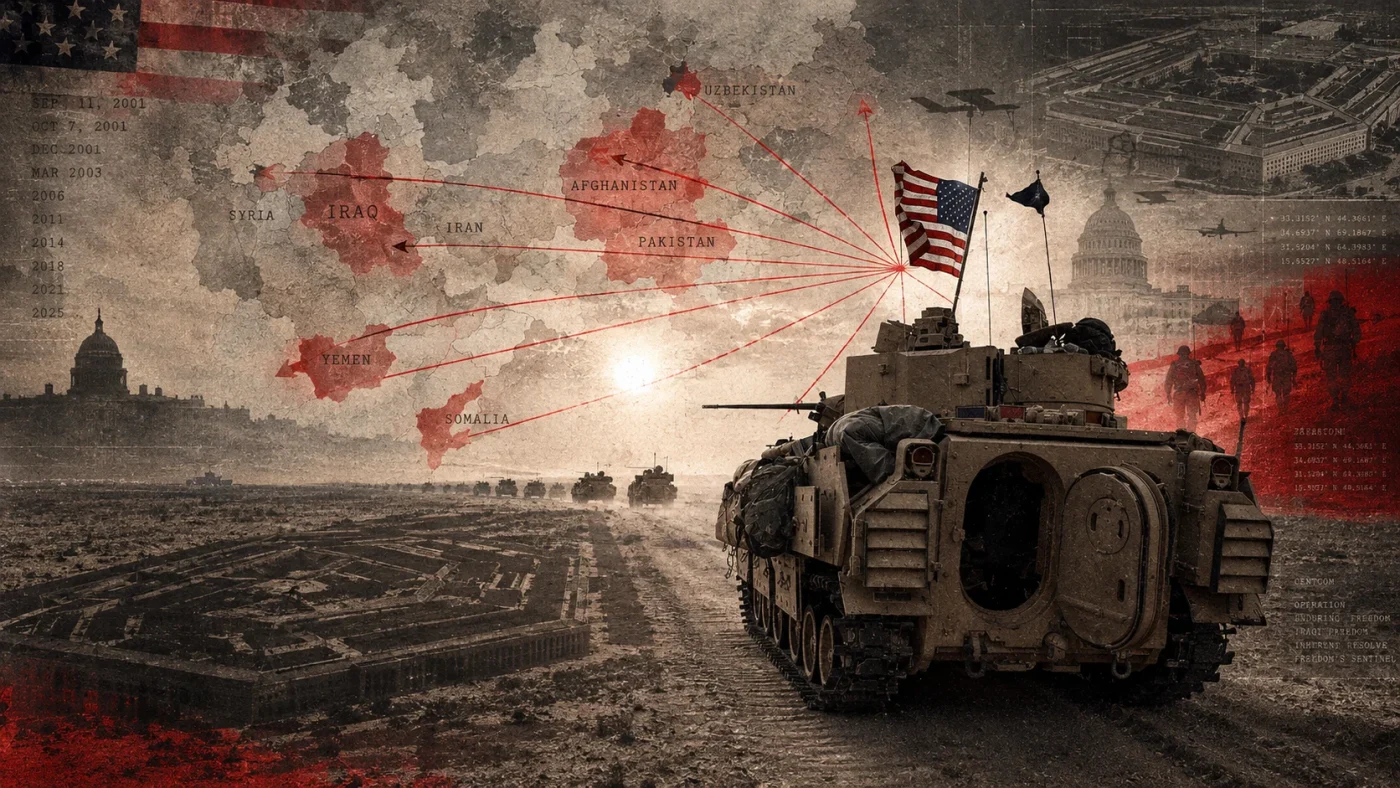
Ask yourself this old question: How did a terrorist attack by a small group of people almost cause the United States to spend the past 20 years waging a war and occupying a nation in the middle of the earth?
The obvious answer is that 9/11 changed everything.
It’s also incomplete.
In her recent essay in Reason, Emma Ashford makes a less comfortable assertion that 9/11 did not fundamentally change American foreign policy. It turbocharged a direction that Washington was already taking in the 1990s. It was the attacks that generated the fear, the political acceptance and sense of emergency which allowed the ideas for intervention to be liberated from restraints they were under.
That distinction matters. If America’s post-9/11 disasters were caused solely by if 9/11 happened again, then the obvious takeaway is to prepare better for the next disaster. However, if 9/11 was just a speed bump on a foreign-policy road that had been worn long before the events of that day, then the fact that the “problem” was never just “terrorism” is a tough pill to swallow. This was Washington’s thinking of American power.
The interventionist impulse came first
The Cold War ended with the United States in a situation never before seen by any great power. Its main military rival had vanished, its economy was dominant and liberal democracy seemed to be spreading everywhere.
It was in this context that the concept of America as ‘the world’s indispensable power’ was born.
During the 1990s, America got involved in Somalia, Haiti and the Balkans. It was an especially notable occurrence when NATO intervened in 1999 against Serbia. Regardless of any opinion on the moral grounds of intervening in Kosovo, it was an instance of an increasing readiness to deploy the American military in nontraditional U.S.- or treaty-bound missions.
The mental atmosphere was following the same trend. The End of History and the Last Man by Francis Fukuyama was the great post-Cold War optimism that liberal democracy hailed the end of the world’s political process. In the meantime, those who supported humanitarian intervention suggested that American power was not only to be deployed to serve American interests, but to stop genocide and remake failed states.
Samantha Power’s A Problem from Hell may have been the most important moral one for this tendency. Her indictment of American inaction in the face of genocide was strong because it called into question the notion that a government responsible for mass atrocities would be immune to outside intervention due to its sovereignty.
The moral issue was not the problem. The issue was that there was a belief that the United States could always use force without any negative repercussions whatsoever.
Then came 9/11
The delineation of punishment, deterrence, counterterrorism and political transformation became fuzzy in the wake of the attacks.
The progression is shown in Afghanistan.
The strategy of eliminating the Taliban and attacking al-Qaeda was simple. Just winning a war is not enough to reconstruct a nation. Washington slowly morphed a counterterrorism effort into a massive state building scheme.
This should have been a red flag.
Rather, it was Iraq that was the greater experiment.
The most vivid irony of the Iraq war is that regime change wasn’t a concept that originated on September 12, 2001. There was already the Iraq Liberation Act passed by Congress in 1998 which officially declared U.S. policy to be regime change in Baghdad. In 2000, the Project for the New American Century (PNAC) published a report titled Rebuilding America’s Defenses, which made a clear case for U.S. global primacy and the reshaping of U.S. military forces to do so.
9/11 did not develop those thoughts.
It made them politically useful.
Overthrowing foreign regimes could suddenly be seen as a battle for freedom versus terrorism. The jargon of democracy promotion became the jargon of national security. Washington was no longer simply protecting the status quo in international affairs. It came to think that it could be re-created.
The mental pitfall was that one.
The central illusion was not military strength. It was political confidence.
America’s military forces were exceptionally at killing things. The error was believing that this would equally enable America to build political legitimacy.
Andrew Bacevich has been working a long time to dissect this contradiction. In The New American Militarism, he outlines America’s increasing dependence on military might to trends that pre-date George W. Bush. In The Limits of Power, he makes the case that the United States had come to embrace a very broad definition of national security that led leaders to think that American freedom could be achieved through an expansion of American power overseas.
That’s an explanation of why Iraq was so badly run even after the conventional military campaign was won.
The invasion was considered the tough part.
It wasn’t.
The hard part came after: building institutions, gaining legitimacy, dealing with sectarian strife, re-building infrastructure, grasping local politics, convincing Iraqis that an occupying army was doing their bidding.
The bureaucratic madness that followed has never been as well documented as in Rajiv Chandrasekaran’s Imperial Life in the Emerald City. Baghdad’s Green Zone was the setting in which American officials tried to build a nation, based on a host of political assumptions, bureaucratic turf wars and remarkable insulation from Iraq reality.
The Assassin’s Gate is worth reading for other reasons. At first, Packer thought that taking out Saddam would lead to a freer Iraq. What he did eventually discover is significant: even those who have a democratic impulse may fall into some error as to how far the gap is between wishing for change and actually creating it.
The deeper failure was bipartisan
It is tempting to describe interventionism as a uniquely Republican disease, but the historical record is far less convenient.
George W. Bush took the most dramatic version of it to Iraq. Barack Obama rejected some of Bush’s rhetoric while preserving significant elements of the interventionist framework.
Libya is the clearest example.
The 2011 intervention began with the stated purpose of protecting civilians from Muammar Qaddafi. But the operation evolved into regime change, while the United States and its allies never developed a convincing strategy for the political vacuum that followed. The result was another demonstration of the same recurring American problem: Washington was often more confident about removing governments than about managing what came afterward.
This is why the post-9/11 story cannot simply be reduced to the neoconservatives or the Bush administration.
The deeper phenomenon was liberal hegemony itself: the belief that American power, properly used, could make the international system more democratic, stable and secure.
Sometimes that belief was expressed in conservative language. Sometimes humanitarian language. Sometimes liberal internationalist language.
The underlying confidence was remarkably similar.
And the bill was enormous
The costs were not merely measured in failed occupations or embarrassed diplomats.
Brown University’s Costs of War Project estimates that the post-9/11 wars have cost approximately $8 trillion when military operations, homeland security, interest and long-term veterans’ obligations are included. It estimates between 4.5 million and 4.7 million deaths, direct and indirect, across the major post-9/11 war zones and more than 38 million people displaced.
Those figures should not be treated as an argument that America should never use force. They are an argument about proportionality. A foreign-policy strategy that consumes trillions of dollars and generations of military attention should produce extraordinary results.
Instead, Afghanistan ended with the Taliban back in power.
Iraq produced regime change but catastrophic instability, followed by the rise of the Islamic State and years of additional conflict.
Libya became another fragmented state.
And while Washington was consumed by the Middle East, China was accumulating economic, technological and military power. That may ultimately prove to be the most expensive part of the post-9/11 era.
The lesson America still struggles to accept
The real legacy of September 11 is not that America became too powerful. It is that Americans became too confident in what power could accomplish.
There is an enormous difference between being able to destroy a regime and being able to replace it. Between defeating an army and building a political order. Between removing a dictator and creating a legitimate government. Between preventing one terrorist attack and attempting to reshape an entire region.
Those distinctions were repeatedly ignored.
The tragedy, then, was not simply that America went to war after 9/11. A country attacked on that scale was always going to respond. The tragedy was that the response became a vehicle for ambitions that had little to do with defeating the people actually responsible for the attacks. September 11 opened the door. Washington had already been walking toward it.
The question for the next quarter-century is whether America has finally learned to stop. Because history suggests that the most dangerous moment for a superpower is not necessarily when it lacks power. It is when it has so much power that it begins to mistake the ability to intervene for the ability to control the outcome.
Comments
No comments on this report yet.
Be the first to join the desk.