 The Washington Probe
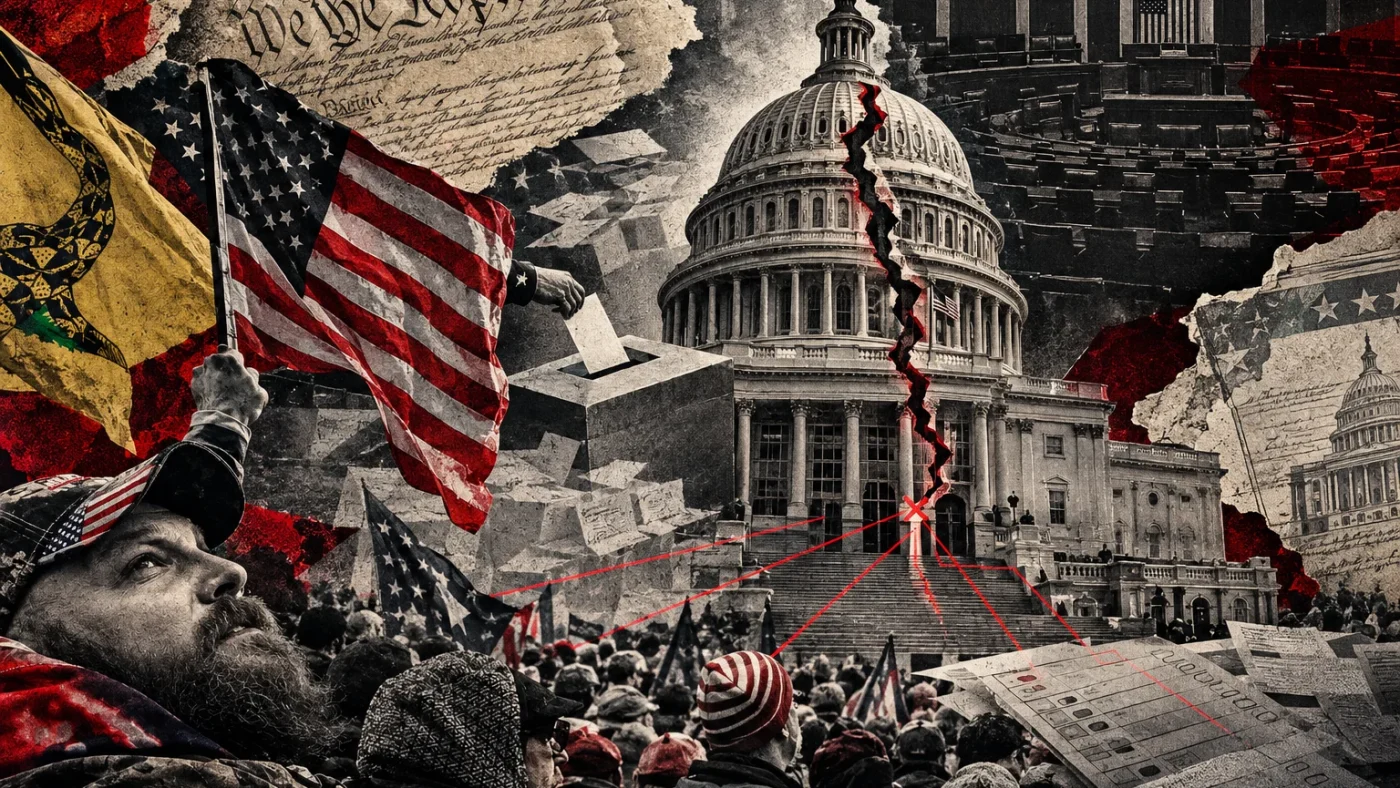
American democracy has a tendency to catch the high of the high and the low of the low. We are reminded of the violence of January 6, 2021 because it was visible, unruly and inescapable. However, the crowd at the barricades is not the only factor that can tear apart constitutional systems. The game cannot be salvaged in some instances, as the real harm is caused in a chamber, by some apparently technical procedure, the effects of which are not reversible.
That is the warning at the heart of former federal judge J. Michael Luttig’s recent essay in The New Republic. Luttig argues that the most dangerous moment surrounding the 2026 midterms could arrive not on Election Day, but on January 3, 2027, when the new Congress is organized. His concern is that a House majority could attempt to prevent duly elected members from taking their seats by challenging the legitimacy of their elections.
Luttig’s scenario is serious. But it is also narrower than the problem it exposes.
The real danger may not be one spectacular attempt to overturn an election. It may be the gradual transformation of electoral democracy into a system in which winning an election is only the beginning of a political struggle over whether the winner is actually allowed to exercise power.
That distinction matters.
The Constitution gives each chamber of Congress authority to judge the elections, returns, and qualifications of its members. But that power is not unlimited. In Powell v. McCormack in 1969, the Supreme Court ruled that the House could not exclude a duly elected member who satisfied the qualifications explicitly established by the Constitution. The case established an important principle: Congress possesses substantial authority over its membership, but it does not possess unlimited authority to redefine the constitutional conditions of membership for political reasons.
Luttig builds much of his argument around that precedent and outlines a hypothetical confrontation involving the House clerk, congressional leadership, federal courts, and ultimately the Supreme Court. The scenario is complicated enough to sound almost surreal. That may be precisely the point. Modern constitutional conflicts do not necessarily arrive wearing the costumes of dictatorship. They can arrive as disputes over clerks, certifications, procedural rules and jurisdiction.
And this is where Luttig’s argument deserves to be expanded.
The vulnerability is not simply whether a particular official might attempt an extraordinary act. It is whether political actors have become sufficiently comfortable with extraordinary acts that the institutional rules themselves cease to provide reliable boundaries.
In Steven Levitsky and Daniel Ziblatt’s book How Democracies Die, they focused on one aspect of the issue. Mutual toleration and institutional forbearance are part of the informality that is essential for any democracy, but just as significant as written constitutions. The opposition parties need to recognize each other as legitimate opposition and the ruling party has to be careful about not going too far when the law allows them to.
That second idea might be more applicable to the year of 2027 than any one of the various constitutional provisions.
In every democracy there are some ambiguities. All constitutions have scope for interpretation. All legislatures have procedural authority which can be exercised aggressively. The system holds up because politicians and others know that the ability to do something does not necessarily imply the need to do it.
When that restraint is gone, the text of the Constitution can shift from being a sort of brake to an arsenal.
It is the kind of behavior that political scientists refer to when talking about constitutional hardball: taking advantage of the formal elements of the system while violating the informal elements of the system that allow them to work together in a way that is congruent with democratic competition. Levitsky and Ziblatt believe this can lead to a vicious cycle. When one side gives in to unrestriction, the other side is willing to give in to unrestriction. Eventually, electoral competition turns into a battle over the survival of the institution, instead of a battle over public policy.
There is another way of not thinking about it just in terms of January 6.
It was a remarkable day January 6! Normalization is the greater risk.
It is not necessary to see moderation, conciliation, and even politeness in all the politicians of a democratic system. Political differences can be intense. Parties can blame each other for their lack of competence, their hypocrisy and their policy of destruction. A democracy that is not able to cope with the fact that the opposition party has no legitimate right to rule when it wins.
Hence, politics of legitimacy is as relevant as the politics of counting ballots.
In the wake of the 2020 presidential election, officials from around the country are reportedly already preparing for a potential federal push into the election administration process, legal challenges, threats, misinformation and disputes. At least 50 election officials spoken to by Reuters this week spoke of preparations for scenarios of political interference and other disruptions.
Important to note is that not all warnings will be realized. That election administration is now turning into a political battleground is it.
This alters the nature of an election.
An election has traditionally two roles. It elects leaders, it resolves a political disagreement. The second one is equally as crucial as the first one. If the results are accepted, then the loser has the option of organising, persuading, collecting money and competing again. If it’s presumed illegitimate, the election doesn’t resolve anything.
Levitsky and Ziblatt have emphasized precisely this point: democracy requires politicians to know how to lose. A defeated party must believe that losing today does not mean permanent exclusion from power tomorrow.
That principle is easy to underestimate because it sounds almost childish. It is anything but.
Democratic government rests on a peculiar bargain. Political actors agree to accept temporary defeat because they believe the system remains open to future victory. Break that assumption and every election becomes existential.
The danger of the January 3 scenario, then, is not merely that some Democrats might be denied seats. It is that such an act would establish a precedent concerning what happens when institutional power and electoral legitimacy collide.
Would Congress remain an institution through which elections are translated into representation? Or would congressional majorities increasingly regard themselves as the ultimate arbiters of which election outcomes deserve recognition?
The distinction is enormous.
Michael Luttig, then, is correct in drawing attention to the little-known event of the creation of a new Congress. It’s not just a hypothetical scenario in which Donald Trump and Mike Johnson, a House clerk or the Supreme Court, would clash. But a more basic one is whether the American political institutions still have enough restraint to work for constitutional democracy when the stakes are so high as to become intolerable.
Madison understood the problem. The constitutional system was designed around competing ambitions because, as Federalist No. 51 famously argued, power had to be structured so that institutions could resist one another. Yet Madison also understood that constitutional architecture could not eliminate the human desire for power. The system depended on institutional friction, but also on the willingness of political actors to recognize limits.
This is the hard-to-swallow reality of 2027.
Perhaps the most important question remaining about American democracy is whether voters received their ballots in good order. It could be if people who don’t like the outcome are okay with it.
That test can’t be entirely delegated to judges. The meaning of constitutional provisions can be considered by courts. They are able to cancel illegal conducts. They have not the power to create democratic legitimacy once political leaders have settled on a rule that losing an election is not acceptable.
Democracy’s machinery is driven by the much more delicate substance of expectations: that losing a political office does not mean for good that this is the end of the political, that opposition is legitimate and that when we win we do not assume unlimited power.
When those assumptions cease to exist, the most dangerous constitutional crisis might not even resemble January 6.
It might appear as if it’s a standard procedure.
Comments
No comments on this report yet.
Be the first to join the desk.