 The Washington Probe
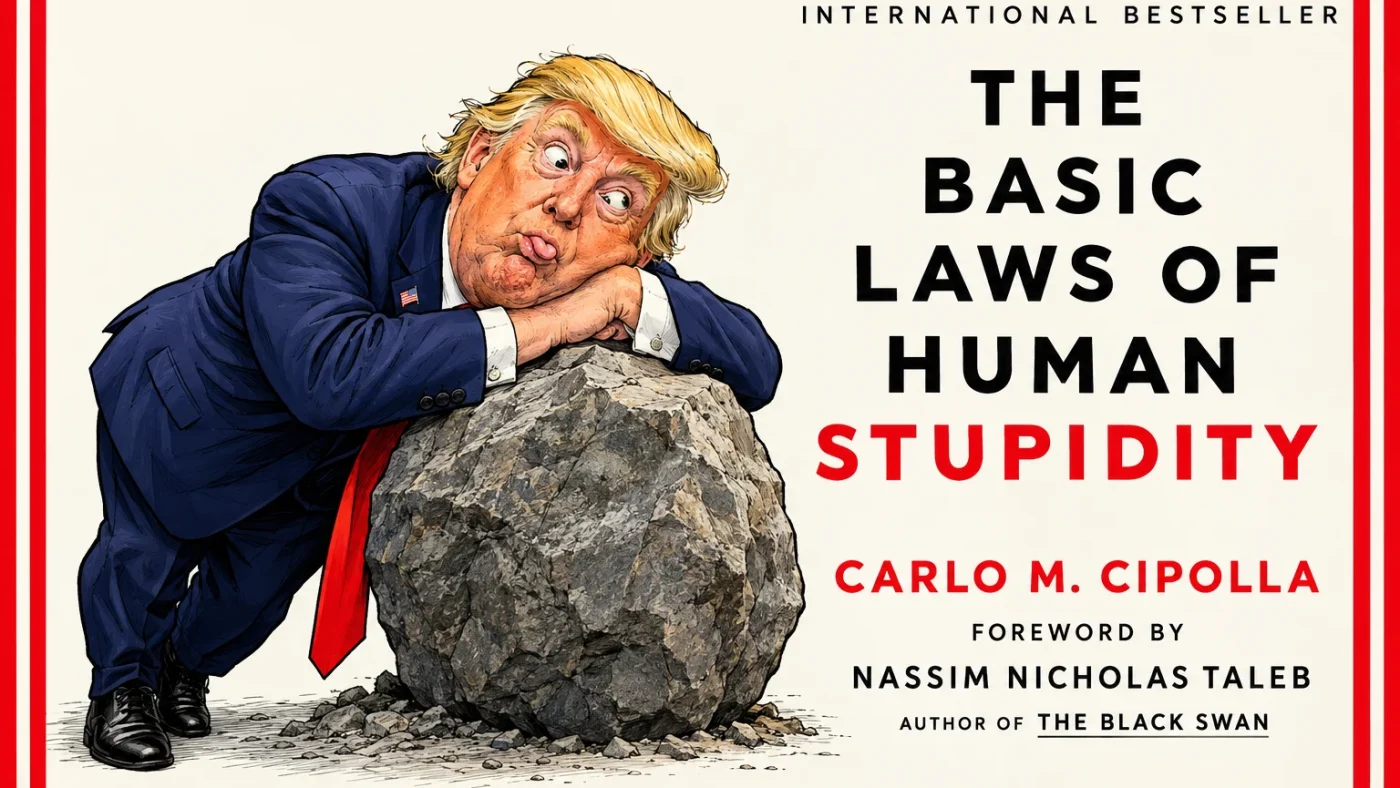
To be so well qualified for the machinery of twenty-first-century government is an odd fate for a work originally circulated privately in 1976 under the spurious imprint of the “Mad Millers.” Cipolla was an economic historian, not a conventional political tract. The essay was finally published in Italian in 1988 and then as an independent English-language edition. This American edition has only 96 pages. Its size is misleading. The argument is small enough to read in an afternoon and large enough to make one distrust an entire civilization.
Cipolla’s trick is to stop treating stupidity as a synonym for low intelligence. He builds a crude but ingenious behavioral taxonomy around a question that economists usually ask in more polite language: Who gains, and who loses?
The intelligent person improves his own position while improving someone else’s. The helpless person harms himself while benefiting others. The bandit gains while imposing a loss on somebody else. Then there is the stupid person: someone whose action produces a loss for others without producing a compensating gain for himself.
That last category is the one that matters.
Cipolla’s famous Second Law says, in full, “The probability that a certain person be stupid is independent of any other characteristic of that person.” Education does not rescue us. Wealth does not. Social status does not. Prestige does not. A résumé can tell you what a person has accumulated; it cannot tell you whether his decisions will make other people better off.
That point becomes more unsettling when applied to modern elites.
The modern world is extraordinary in its capacity to pay for qualifications. Diplomas, top schools, professional credentials, institutional connections, security clearance, executive office: all can be considered measures of competence. The risk is in taking the proxy for the actual.
A credential is evidence of selection. It is not evidence of judgment.
Cipolla’s framework is especially useful here because it refuses the comforting assumption that serious damage must have a serious motive behind it. Corruption at least contains a logic. The corrupt official wants something. The grifter wants money. The political operator wants influence. The institutional predator wants territory.
Cipolla calls the bandit’s reasoning a form of “nasty rationality.” That is a crucial distinction. A rational adversary, however ugly his interests, remains partly intelligible. You can anticipate what he wants and construct defenses around those interests.
Stupidity is harder.
Cipolla’s stupid actor is dangerous precisely because the outcome cannot be reconciled with a coherent account of self-interest. The person inflicts damage without obtaining an equivalent benefit. The behavior may even hurt the person carrying it out. This is not simply bad policy. It is a breakdown in the ordinary assumption that human beings respond to incentives.
Institutions are founded on that assumption.
Rules, procedures, forecasts, incentives, professional expertise, and chains of accountability are essential attributes of modern bureaucracies, which assume that humans can be described as actors who react, in a more or less adequate fashion, to predictable interests. Markets do this. Governments do it. Diplomacy does it. Military planning does it. Democratic politics does it.
What happens when the people exercising power repeatedly violate the assumptions beneath the system?
This is where Cipolla becomes much more than a satirist.
The most important section is not really about the stupid individual. It is about the power of stupidity. Cipolla argues that social, political, and institutional power magnifies the damage a stupid person can cause. A foolish decision made at a dinner table is regrettable. A foolish decision made inside a ministry, a central bank, a military command structure, or a technology company can become a population-wide event.
Scale changes everything.
One misjudgment one hundred years ago could be the downfall of a family business. Today, a wrong decision can spread through financial markets, information networks, supply chains, weapon systems, or automated systems before anyone realizes what happened.
This means a peculiar modern paradox. Human beings have grown extraordinarily adept at building machines that fly and operate on scales too large for anyone to imagine simulating on their own. Yet, the political component that guides them remains subject to vanity, factionalism, incompetence, and short-term incentives.
With artificial intelligence, the problem is reduced to almost an embarrassment of riches. Technologies don’t have to be “stupid” to be “stupid”. A very complicated system can be put in place with poorly designed rules, or run by institutions that fail to grasp the incentives, or managed by individuals who have more confidence than understanding.
The machine can be a genius.
The person making the decision need not be the decision maker.
Nuclear weapons earlier created this problem. The technological feat was awesome, but the political reaction faced one simple reality: Destructive capacity can outrun wisdom. The same pressure is being felt in digital systems that are easily replicated and can be distributed worldwide.
Cipolla’s framework also reveals a limitation on the standard accountability language of democracy. In many ways, elections become a way to redeem one’s poor judgment. Voters select, politicians, react, outcomes follow, and voters hold politicians accountable for the downfalls.
However, the system assumes that the failures will be readable before the next decision is made.
But they don’t always.
Some political errors have come with repercussions years later. Others redistribute costs so that the damage falls on someone who didn’t make the decision. Others, again, are cloaked in ideology, partisan identity, or institutional glory until enough evidence emerges that it becomes politically impossible to believe it.
Then, lack of competence can become self-protective.
The institutional problem is not simply that corrupt people have learned how to manipulate the system. It is that organizations can normalize irrational behavior because too many participants benefit from pretending that it is rational. Meetings continue. Reports are written. Metrics are produced. Experts are consulted. Nobody has to announce that the machine is making less and less sense.
This is why Cipolla’s Fourth Law is so unnerving. He argues that even intelligent people systematically underestimate the damage stupid people can cause. Rational observers expect a rational response. They assume evidence will matter, failure will impose a cost, and self-interest will eventually reassert itself.
Sometimes none of that happens.
The result is not a society with no intelligence. It is something more peculiar: a society in which intelligence and competence are increasingly concentrated in systems whose political guardians may be unable to use either responsibly.
That is a more serious diagnosis than the familiar complaint that public life has become foolish.
Cipolla ends up less interested in stupidity as a personal defect than in its political distribution. His Fifth Law delivers the blunt verdict: “A stupid person is more dangerous than a bandit.” The claim sounds absurd until one thinks about scale. A bandit wants something. That desire creates limits. The stupid actor may have no corresponding limit because no coherent calculation governs the harm.
That is the book’s enduring discomfort.
It doesn’t say that America has become a little dumber. It implies a more dire possibility: that the institutions of today are so strong that the irrational behavior of the ordinary human being can spread further, faster, and with greater impact than what Cipolla could have envisioned in 1976.
The great political question, then, is not how to eliminate stupidity. Cipolla never seriously offers such a fantasy.
It is how to prevent it from acquiring an architecture.
Comments
No comments on this report yet.
Be the first to join the desk.